

During the "Eleventh Five-Year Plan" period, China's national economy achieved sustainable and rapid growth, ultimately leading to an upsurge in the production of beverage goods. As manufacturers emphasized automation and output rates for their machines, it promoted further development of this sector. The success of numerous products on store shelves is a testament to how far this industry has come over such a short period!
Beverage industry giants, such as beer producers, experienced a slight year-on-year growth from January to December 2018. According to the National Bureau of Statistics data, the cumulative output for enterprises with annual primary business revenue exceeding 20 million yuan was 38.122 million kL - an increase of 0.5% compared to 2017's figures. Additionally, China saw a 2.3% year-on-year growth in December 2018 alone, with total outputs reaching 2.089 million kL that month!
Beer businesses are seizing the chance to tap their potential and reduce costs through technological advancements while they compete in the market. As enterprises embrace technological advances, packaging equipment within beer production lines shows signs of transformation as an essential part of beer company output.
01.
 At the analysis meeting for transforming box packaging equipment, our technical team carefully evaluated feedback from plant operators and electricians. With their input, we were better equipped to formulate a precise control protocol that would create long-term success within the organization.
Upon examining and investigating this type of line packaging equipment's working process and its control characteristics in-field, it became evident that digital signals comprised both input and output units; these came from photoelectric switches, proximity switches, solenoid valves, stepper motors, etc. Moreover - for an efficient production process - continuous process control was necessary.
The PLC-based control system is unrivaled in its digital, logical, and sequential control capabilities; therefore, the project's control mode has been uniquely designed to harness these advantages.
To unify spare parts and facilitate daily maintenance of the brewery equipment following its renovation, Siemens S7-200 PLC was determined to be the most suitable controller for this new system due to its vast number of acquisition and control points. Considering the DI/DO scale, communication network configuration, and potential future upgrades, CPU 226 and analog & digital expansion modules were chosen accordingly to ensure optimal performance.
The control system's main CPU comes with 13K bytes of data storage, 40 DI/DO (24DI/16DO) integrated into the CPU module, and can expand to 7 I/O modules (248 digital or 35 analog I/O points). This powerful setup has 6 independent high-speed counters and 2 independent high-speed pulse outputs built into the CPU module. In addition, 8 PID controllers are available through special software commands. This incredible feature set gives you full access to AO/DO mode output configurations.
This CPU is equipped with two physical RS485 communication/programming ports, fully compatible with the control system used in this retrofit. These ports guarantee seamless PPI and MPI protocols and freely programmable port communication.
03.
 (7)The PLC control system unified collects and renders the temperature, pressure, and other parameter measuring instrument signals of the original filler line steam measurement by its production requirements.
(8)To allow the operator to quickly understand how the entire assembly line operates, a Siemens KTP700 Basic touch screen was set up on-site post-system alteration. This touchscreen is connected to the PLC control system through an MPI communication port and clearly displays different process parameters and operations for better comprehension.
04.
 (3)Following the A, B, and Z phases of the encoder found in the beer canning line speed measurement outlined in its instruction manual, they were connected and configured through Siemens's MicroWIN V4.0 SP9 programming software to achieve an accelerated rate of counting with a reset via Z phase plus function. When pressing button 5SA or reaching pre-set parameters such as overspeed and stall speed limits, the conveyor motor will shut down promptly, which should also prompt packing equipment to cease operation simultaneously.
(4)To control the start and stop of the beer inlet motor, beer outlet motor, and bottle shifting motor independently, press either the operation button on the equipment or its equivalent soft button displayed on-screen. After use, ensure all switches are reset to "OFF." 1SA and 2SA regulate "exit arm" and "bottle positioning," respectively; 10SA and 15SA both manage "guide" with one regulating for a variable distance.
(5)After debugging the simulation, once all of the equipment's settings are correct, switch to the "automatic" gear and press the "system operation" button. Doing so will initiate automatic beer packing operations—and voilà! You're done.
06.
Status Quo and Solutions
In producing beer and other bottled beverages, the packaging node usually uses a versatile filling line with linkage boxing. This equipment allows for the simultaneous packing of 4 boxes (cartons, plastic, polypropylene, or any other material) which consist of 24 bottles each - up to 3 boxes can be filled at once. As part of the continuous manufacturing process, rod boxing packages are mainly employed to pick up and lift finished beverage liquids and reset various containers afterward. Highly reliable and straightforward in structure, this specific equipment is vital to liquid beverage manufacturers' filling lines. At the packing and packaging node, its importance shines brightest, as it functions as the epicenter of the entire line system despite not being directly linked with beer production. As a result, automation of production processes becomes much more achievable! Controlling its electrical instrumentation is paramount to ensure the safe and reliable operation of the packaging machine in the liquid filling line. Currently, the majority of beer production companies depend on a combination of 89C series control units and ARM microcontrollers to conduct their filling line equipment. This system is intricate in its design and susceptible to interference due to the multitude of relays integrated within it; moreover, with beverage manufacturing taking place under hot and humid conditions, packing node failures are common occurrences that can lead directly cause disasters. Moreover, for the system powered by a microcontroller control board, daily maintenance and troubleshooting require specialized instruments and professional expertise from trained personnel, thus amplifying corporate expenditure in labor costs. As modern control technology advances, PLC control quickly becomes the go-to production equipment choice. It's unsurprising that this tendency is found in an array of machinery, such as the connecting rod box packaging system: automating manual processes increases productivity while reducing daily maintenance duties and personnel instruction. Considering the specific requirements of beer manufacturers, Liaoning China Resources Snow Group emerged as our top choice for modernizing their carton packing and packaging machinery on their filling line. This selection was based off both objective factors and current market trends. 02.Control system structure
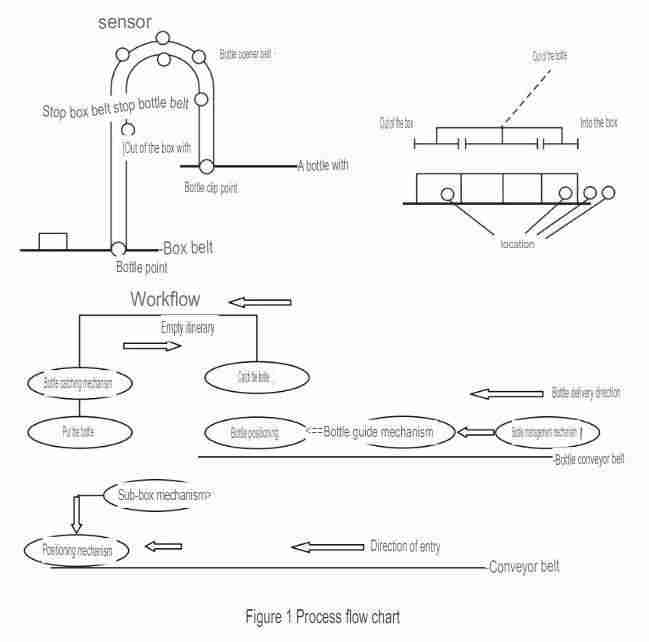
This beer manufacturer trusts a reliable and multipurpose filling line system to ensure consistent quality assurance (as illustrated in Figure 1). It comprises of an electric motor, microcontroller control board, as well as other essential components.
At the analysis meeting for transforming box packaging equipment, our technical team carefully evaluated feedback from plant operators and electricians. With their input, we were better equipped to formulate a precise control protocol that would create long-term success within the organization.
Upon examining and investigating this type of line packaging equipment's working process and its control characteristics in-field, it became evident that digital signals comprised both input and output units; these came from photoelectric switches, proximity switches, solenoid valves, stepper motors, etc. Moreover - for an efficient production process - continuous process control was necessary.
The PLC-based control system is unrivaled in its digital, logical, and sequential control capabilities; therefore, the project's control mode has been uniquely designed to harness these advantages.
To unify spare parts and facilitate daily maintenance of the brewery equipment following its renovation, Siemens S7-200 PLC was determined to be the most suitable controller for this new system due to its vast number of acquisition and control points. Considering the DI/DO scale, communication network configuration, and potential future upgrades, CPU 226 and analog & digital expansion modules were chosen accordingly to ensure optimal performance.
The control system's main CPU comes with 13K bytes of data storage, 40 DI/DO (24DI/16DO) integrated into the CPU module, and can expand to 7 I/O modules (248 digital or 35 analog I/O points). This powerful setup has 6 independent high-speed counters and 2 independent high-speed pulse outputs built into the CPU module. In addition, 8 PID controllers are available through special software commands. This incredible feature set gives you full access to AO/DO mode output configurations.
This CPU is equipped with two physical RS485 communication/programming ports, fully compatible with the control system used in this retrofit. These ports guarantee seamless PPI and MPI protocols and freely programmable port communication.
03.
System function design
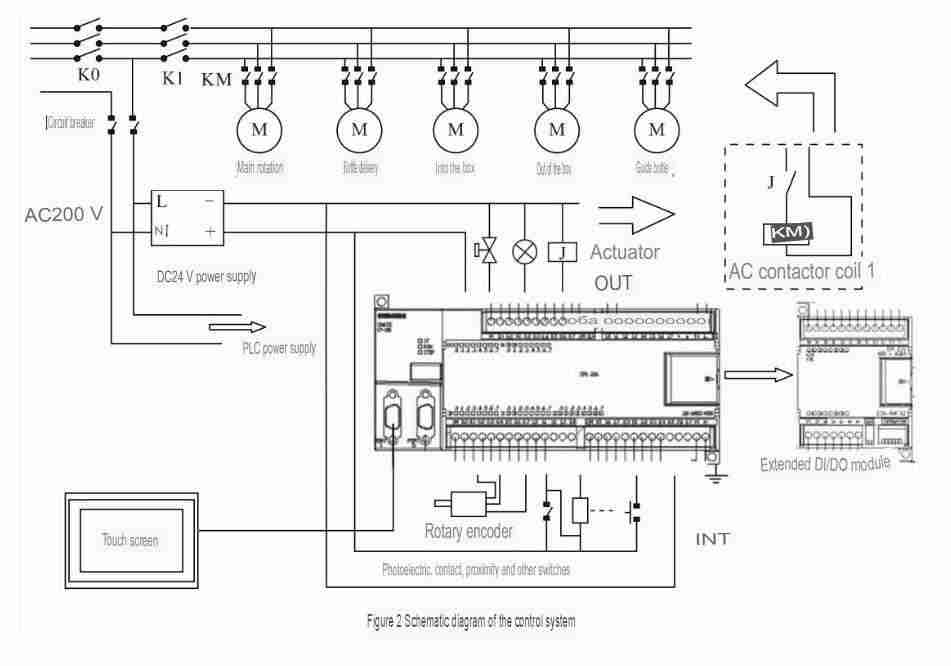
(1)The motor of the control system for packager equipment can switch between point, forward, and reverse drive to bring about a reciprocal movement for bottle clamping. Two engines handle bottles and boxes, respectively, while seven solenoid valves manage the "gripper," "positioner," "outgoing box arm," and "box guide," as well as manual and automatic operations. Among them are two changeover switches regulating manual or automated manipulation. (2)To ensure the protection of operators, three ultra-sensitive photoelectric sensors are installed on the control panel and both sides of the packaging equipment. When triggered by someone accidentally entering a hazardous area around the machine, these detectors will immediately halt their operation. (3)Omron Japan's specially-designed rotary encoder is installed on the conveyor belt of our beer canning line, allowing us to accurately calculate the speed. If our PLC system notices any abnormalities with the motor running at an abnormal rate, it will shut down promptly and safely stop all packaging equipment from working. (4)The PLC system hosts a wide range of signal inputs, from photoelectric and proximity switches in the DI circuit to DC24V solenoid valves in the DO circuit. Moreover, this revised version has an additional SIEMENS DC20A output STOP power supply covering peripheral sensors and actuators for enhanced stability across all input/output components. For example, Figure 2 provides a schematic illustrating its effective control system design. (5)To guarantee the reliable performance of the improved control system, multiple protective measures were taken into account during design. The power equipment is grounded individually in terms of grounding, with a cross-sectional area above 2mm2; furthermore, a unique terminal guaranteeing insurance has been connected to PLC input while relay isolation was applied to DO for isolating the actuator drive coil & PLC terminal, hence eliminating any interference within the system that may arise from the electromagnetic shock upon sucking and disconnecting its coil. (6) We've designed a safety device to guard against any potential harm or injury inflicted on workers during operation. This device comprises optical and proximity switches to create an enclosed zone, which is impenetrable under normal circumstances. If the operator ventures into this no-go zone or the protective door are opened while working with the equipment, logic will kick in and promptly shut down and alarm the whole assembly line.
(7)The PLC control system unified collects and renders the temperature, pressure, and other parameter measuring instrument signals of the original filler line steam measurement by its production requirements.
(8)To allow the operator to quickly understand how the entire assembly line operates, a Siemens KTP700 Basic touch screen was set up on-site post-system alteration. This touchscreen is connected to the PLC control system through an MPI communication port and clearly displays different process parameters and operations for better comprehension.
04.
Control system program design
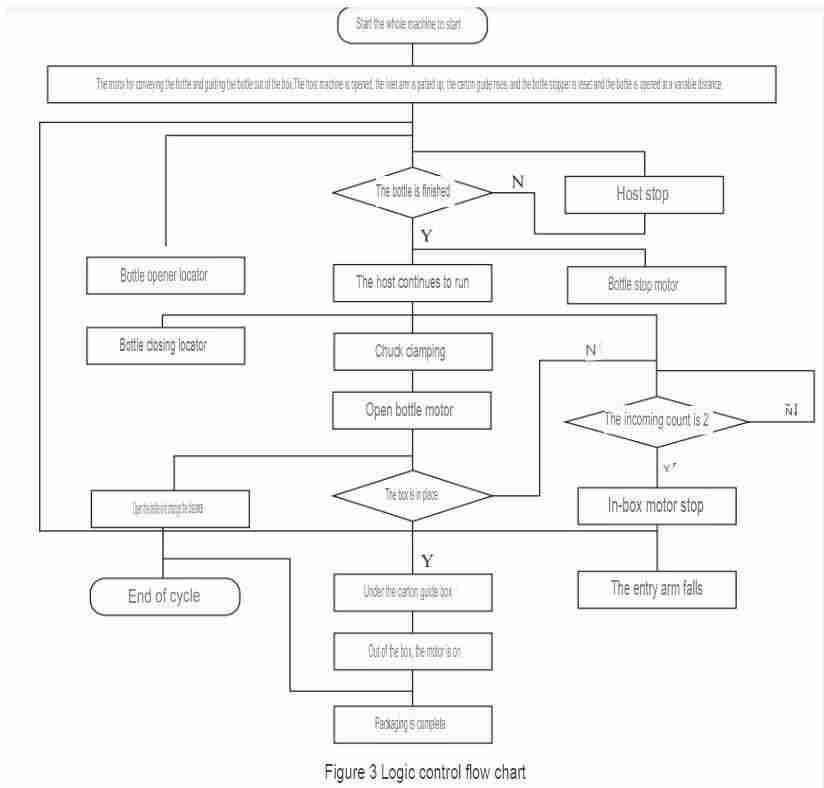
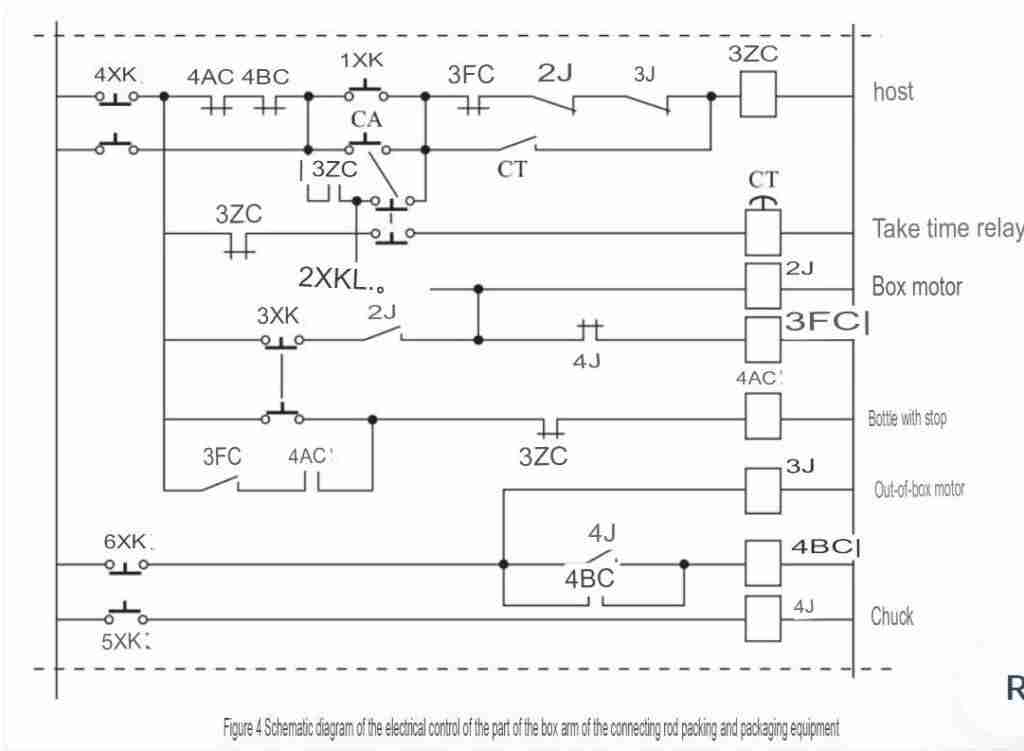
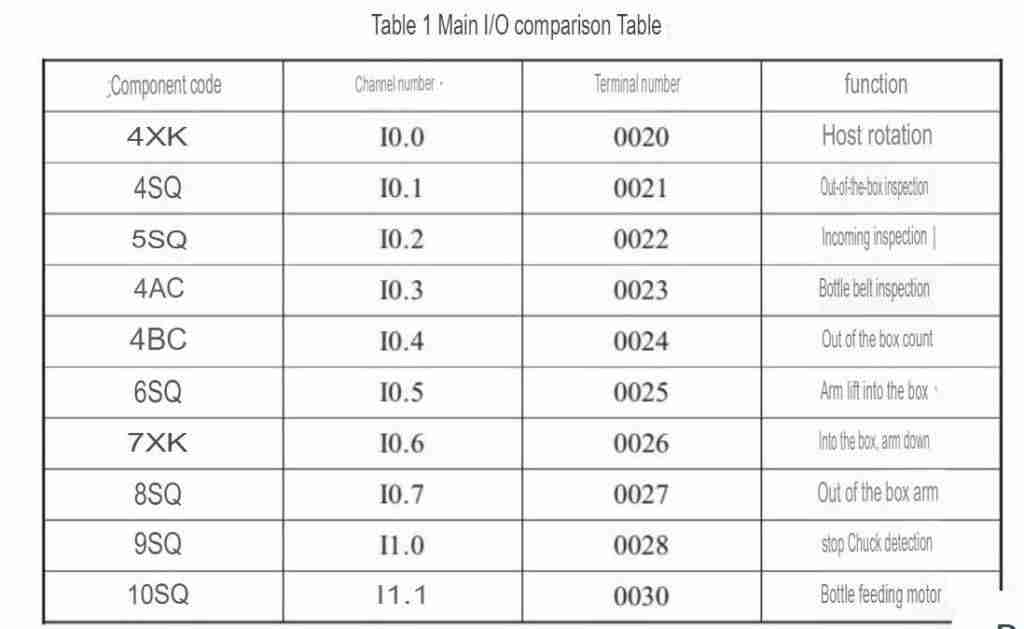
System programming is broken down into two sections: PLC program design and touch screen program design. The primary objectives of touch screen program design involve configuring the driver, connecting variables, and setting up the operational display. Utilizing Siemens MicroWIN V4.0 SP9 software, this document presents the design of a PLC program and its accompanying logic control flow chart (depicted in Figure 3). Drawing upon the electrical control principles and wiring diagrams of packagers in an assembly line, our PLC control system hardware is carefully crafted to efficiently regulate operations. During the transformation process, we take the original equipment's DI/DO signals and use them as input/output points of our PLC system. We then replace any control functions originally completed by relays, time relays, or other hardware with programming from within our new PLC System. As demonstrated in Figure 4, the electrical control schematic of the modified equipment has been incorporated into the box arm unit. A comprehensive I/O comparison table of the inlet arm section is presented in Table 1. 05.Examples of debugging for lifting and moving actions of packaging equipment
(1)To ensure the PLC system's DI channel HR0003 alarms properly, adjust each photoelectric sensor SQ1 to its mechanical limiting position and symmetrical reflector plate so that when it is in "conduction" condition, there should be a "light blocking" state present. Follow suit with installing photoelectric switches SQ2 through SQ10 for optimal performance. (2)To ensure that the PLC system DI channel box HR0012 reset indicator is on, adjust the installation distance of the photoelectric sensor proximity switch JQ0 and symmetrical reflector plate according to the mechanical limit position of the falling arm lever so that it reaches close to "block" position at its trajectory lowest point. Adjust JQ2, JQ3, JQ4, and JQ5 similarly for perfect results.
(3)Following the A, B, and Z phases of the encoder found in the beer canning line speed measurement outlined in its instruction manual, they were connected and configured through Siemens's MicroWIN V4.0 SP9 programming software to achieve an accelerated rate of counting with a reset via Z phase plus function. When pressing button 5SA or reaching pre-set parameters such as overspeed and stall speed limits, the conveyor motor will shut down promptly, which should also prompt packing equipment to cease operation simultaneously.
(4)To control the start and stop of the beer inlet motor, beer outlet motor, and bottle shifting motor independently, press either the operation button on the equipment or its equivalent soft button displayed on-screen. After use, ensure all switches are reset to "OFF." 1SA and 2SA regulate "exit arm" and "bottle positioning," respectively; 10SA and 15SA both manage "guide" with one regulating for a variable distance.
(5)After debugging the simulation, once all of the equipment's settings are correct, switch to the "automatic" gear and press the "system operation" button. Doing so will initiate automatic beer packing operations—and voilà! You're done.
06.
Epilogue
The brewery saw impressive results by upgrading to a new beer filling line with modern packaging equipment: decreased physical wiring for their control system and smaller dimensions in their control cabinet. Furthermore, automation was improved along with the operational trustworthiness of the apparatus. Lastly, maintenance personnel enjoyed reduced labor due to increased efficiency. This paper outlines an exemplary, universal retrofit case that indicates similar equipment control systems in the industry. The design solutions and reliability showcased here reflect all retrofitting efforts undertaken. Additionally, our PLC system is compatible with a multitude of different filling machines and equipment including those used in the creation of CSD beverages, bottled water production lines, and fruit juice packaging processes. Our cutting-edge automation technology offers users an effective yet dependable way to regulate their beverage filling line operations from blow molding through water treatment all the way up to beverage packaging – empowering them to get peak results out of every step! Here’s wishing you success for all your upcoming projects! Bottoms up for optimal control on beverage filling lines - Cheers! If you're looking for a reliable and cost-effective turnkey solution for your beverage filling line, look no further than iBottling. Our highly experienced engineers have the expertise to ensure the best performance of your line and the most efficient use of resources. Get in touch today and let us help bring cutting-edge automation to your production process!Reference:
- https://new.abb.com/plc/references/by-date/cutting-edge-solutions-for-food-packaging-at-ilapak-international
- https://www.healthtekpak.com/filling-and-sealing/shubham-automation/
- https://packagingsouthasia.com/technology/automation/shubham-automation/
- https://shemeshautomation.com/blog/shemesh-launches-new-rotary-piston-filling-machine/
- https://www.emerson.com/nl-nl/automation/fluid-control-pneumatics/factory-automation
- https://automation.omron.com/en/us/solutions/success-stories/jomet-packaging-success-story
- https://www.rockwellautomation.com/en-us/industries/food-beverage.html
- https://www.pilz.com/en-INT/products/controllers/software
- https://www.br-automation.com/en/about-us/customer-magazine/2017/2017-interpack/the-mass-customization-balancing-act/
- https://www.packagingdigest.com/automation/integrated-motion-control-technology-brewery-boosts-speed-and-accuracy-its-packaging
- https://www.eldon.com/en/News/?c=818



