



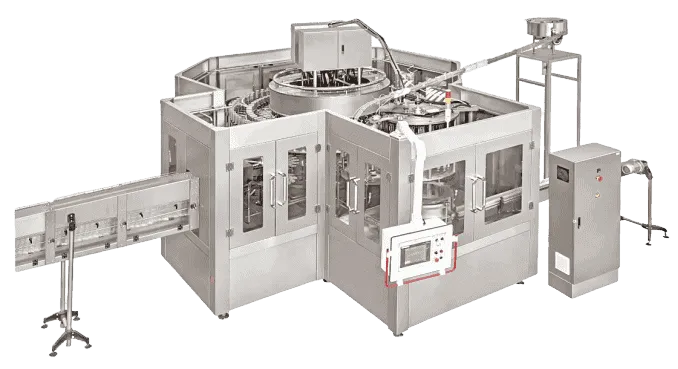
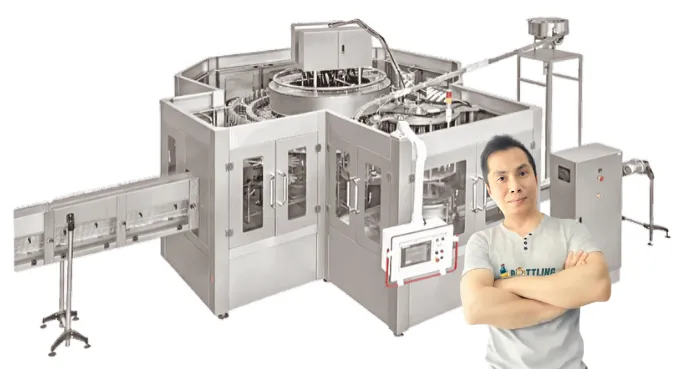
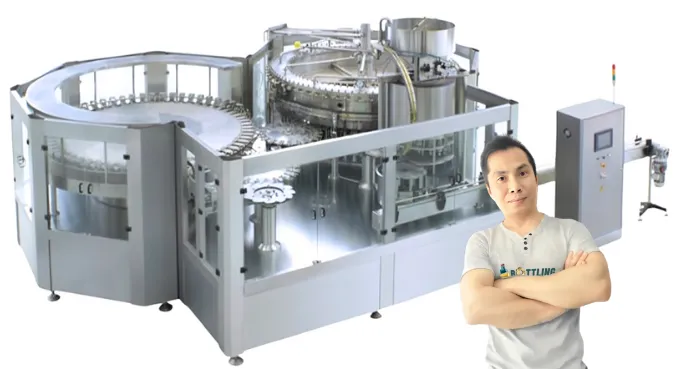
PET hot-fill rinsing · filling · capping

PET Hot Fill Juice Bottling Machine Up to 28,000 bottles/h.

Hot Fill Juice Bottling Machine for PET hot juice, pulp juice, and hot tea—up to 28,000 bottles/h, 50 heads, published 500 mL module. FAT-ready documentation.

28,000 bottles/hPublished peak (500 mL)
50 filling headsPublished maximum
Hot juice · pulp · teaPublished beverage types callout

Get a Quote

Since 1995 · CE & ISO 9001 · 150+ countries

Hot Fill Juice Line Capability Highlights

PET HOT-FILL MONOBLOCKTEMPERATURE-DISCIPLINED JUICE & TEARINSE / FILL / CAP INTEGRATIONFACTORY ACCEPTANCE SUPPORTPULP · NFC · HOT TEA
PET hot-fill rinsing, filling, and capping for juice and teaServo-driven changeovers—per published copyStainless steel product-contact constructionPublished capacity band 3,000–28,000 bottles/h (500 mL)
PET hot-fill line economics

Built for proven hot-fill throughput.

The public equipment page pairs PET hot-fill rinsing, filling, and capping with marketing claims around servo-driven changeovers , Steplead certified parts , and stainless steel construction —restated here without adding new mechanical figures beyond what appears in the published specification module for this Hot Fill Juice Bottling Machine .

Published peak output
28,000Bottles/h
Published beside the headline as “Up to 28,000 bottles per hour” with 500 mL called out in the specification banner.
Filling stations
50Heads max
Matches the published “Up to 50 filling heads” icon callout beside the hero headline.
PET Hot Fill Juice Bottling Machine rated output equipment

PET Hot Fill Juice Bottling Machine — Published 28,000 bottles/h

Published peak output
Up to 28,000 bottles per hour (500 mL headline)
Filling heads
Up to 50 filling heads (published callout)
Beverage scope
Hot juice, pulp juice, and hot tea (published icon strip)
Satisfaction Guaranteed
2 Years Quality Warranty
Overseas Engineer Support Available
On Time Delivery Guaranteed

Fruit juice hot-fill overview.

Published equipment copy describes a fruit juice filling machine for hot liquid filling on PET, including marketing language about temperatures up to 90 °C , JNSDIT-style beverages, and minimized downtime with container format flexibility . The statements below condense that narrative while keeping capacity claims tied to the published icon callouts and specification banner on the Hot Fill Juice Bottling Machine .

PET hot-fill core

Published copy positions the monoblock for hot juice, pulp juice, and hot tea with temperature-disciplined filling before closures—repeat here without adding new thermal curves beyond the 90 °C marketing ceiling.

Integrated rinsing & capping

Marketing copy positions rinsing, filling, and capping as one continuous juice bottling line to save floor space versus split islands.

Format flexibility story

Published advantages cite servo motors, stainless construction, and a user-friendly interface for switching container formats—repeated here without new numeric guarantees.

Operational Excellence.

UP TO 50%

Published advantage block cites Steplead certified parts with extended warranty language for the fruit juice filling machine and hot liquid filling line story.

UP TO 25%

Marketing copy on the published page claims less maintenance for the fruit juice bottling machine versus conventional systems in the same module.

UP TO 20%

Energy narrative references lower engine speed with a larger hydraulic pump without altering the published percentage headline.

The Core: Rinse. Fill. Cap.

Each step below reuses the photography URLs from the original fruit juice hot-filling machine listing so rinsing, filling, and capping imagery stays aligned with the same on-site modules—your juice filler monoblock core for a complete fruit juice bottling line , with hot filling equipment hygiene checkpoints called out beside each photo.

Rinsing station ahead of PET hot-fill juice filling

Efficient container rinsing

  • High-pressure rinsing removes dust and impurities before hot product enters the bottle.
  • Published copy notes customer-supplied water or media for the rinse circuit—capture quality specs in RFQ packs.
  • Positions bottles cleanly before hot filling to protect beverage quality.
Rotary filling system for hot juice and tea

Hot-fill filling core

  • Published marketing describes hot liquid filling with controls aimed at pulp handling and fill-level stability for NFC-style juices.
  • Marketing copy cites temperatures up to 90 °C—treat every thermal setpoint as quotation- and FAT-defined, not a universal guarantee.
  • Maintains the published rinse/fill/cap story for PET juice and tea when upstream pasteurization and cooling match project design.
Capping system closing hot-filled PET juice bottles

Secure capping

  • Applies closures immediately after filling to lock in hygiene and shelf-life expectations for hot-filled PET.
  • Published copy stresses leak prevention—treat torque, cap family, and induction foil options as FAT-defined items.
  • Completes the three-function block shown on the published layout diagrams.

PET Hot Fill Juice Bottling Machine specifications.

3,000 ~28,000 bottles

The published price table headline reads 3,000 ~28,000 Bottles with a 500ml / Per Hour subline—pair that headline with the checklist below when you lock RFQ acceptance around neck, cap, pulp, and thermal profiles.

Engineering Highlights

  • ProcessPET hot-fill rinsing, filling, and capping per the published overview modules
  • ConstructionStainless steel framing and servo-driven changeover story from the published advantages section
  • UtilitiesHot product supply, cooling, steam/CIP, and customer-supplied rinse media must be defined per project—no extra utility numbers added beyond the published 11 Kw callout in the table
  • Quality systemsProject documentation can be aligned to ISO 9001:2015 quality management principles during factory acceptance.

Specification rows mirror the published “PRODUCT SPECIFICATIONS of Fruit Juice Filling Machine” price-table module on the original equipment detail page. The ISO link explains the standard’s intent; it is not an on-page certificate claim.

Fruit juice filling machine — published specification module

The public “PRODUCT SPECIFICATIONS of Fruit Juice Filling Machine” price-table module lists rinsing valves, filling valves, capping heads, power, and overall dimensions beside the 3,000–28,000 bottles headline for the Hot Fill Juice Bottling Machine . Values below are copied from that module; anything outside it is N/A (not specified in the available product data) .

  • Valve & head counts 50 rinsing valves, 50 filling valves, and 12 capping heads as published in the original specification list.

  • Throughput headline 3,000–28,000 bottles per hour at the 500 mL reference called out beside the published headline figures.

  • Power 11 Kw electrical demand as published in the same module (verbatim “11Kw” spelling on source).

  • Footprint Overall dimensions 5,300 × 4,200 × 2,900 mm as listed in the product specification.

ItemSpecification
Rinsing valves50 (published)
Filling valves50 (published)
Capping heads12 (published)
Power11 Kw (published as “11Kw”)
Overall dimensions (L × W × H)5,300 × 4,200 × 2,900 mm (published)
Published headline throughput3,000–28,000 bottles per hour with 500 mL / per hour subline

Layout collection & line PDFs.

The published layout carousel on this juice hot-fill equipment page still pointed at the same two carbonated soft drink PDFs hosted under the February 2022 uploads folder, with slide copy referencing soda/cola lines for 500 mL–2 L PET. Those absolute URLs and verbatim slide titles are preserved below for traceability—request juice-specific GA drawings from sales if your bottle track diverges.

REF: CSD-LAYOUT-PDF-BUNDLE (ORIGINAL CAROUSEL)
5 gallon filling line equipment layout reference with monoblock and process flow arrangement
Thermal & water stewardship

Balance hot-fill energy without inventing new utility tables.

Published energy narrative

Marketing copy cites up to 20% energy savings through lower engine speeds and a larger hydraulic pump—restated here as the same storytelling shape as the original published page, not a measured savings guarantee.

Rinse & cooling discipline

Hot juice and tea runs depend on disciplined rinse water, flash cooling, and pasteurization handoffs; map those loads to your chiller, tunnel, and blending assets before locking utility budgets.

Juice hot-filling walkthrough.

“Once pasteurizer exit temperature, hot-fill setpoints, and capper torque were scripted into the same FAT matrix, our PET juice runs stopped drifting on fill height—we finally held the published 500 mL band without rework.”
Head of bottling operations — Regional juice co-packer, Southeast Asia
Exported to 150+ Countries24/7 Rapid Response SupportTurnkey Engineering Services

Get a Quote for This Machine

Since 1995 · CE & ISO 9001 · 150+ countries

Hot juice filling machine for PET bottles

This hot juice filling machine is a rinse-fill-cap monoblock built for PET bottles. Juice is filled at hot-fill temperature and capped straight away in the same machine. The published configuration reaches up to 28,000 bottles/h with 50 filling heads.

As a PET bottle juice filling machine, it handles fruit juice, juice drinks and tea, and it works as a hot liquid filling machine for other non-carbonated drinks that are filled hot. For upstream syrup preparation, see the sugar dissolving tank; for a full plant, see the juice hot-fill line. Coding after the capper is handled by a bottle coder, and roll-fed labels by an OPP labeling machine.

FAQ — PET hot-fill juice procurement

How do the hero “28,000 bottles/h” claims relate to the published price-table module?
The icon strip on the Hot Fill Juice Bottling Machine advertises up to 28,000 bottles per hour while the published checklist lists 50 rinsing valves, 50 filling valves, and 12 capping heads beside the same 3,000–28,000 headline band. Treat any residual mismatch between marketing icons and mechanical tables as a quotation- and FAT-reconciliation item—do not assume both are guaranteed simultaneously without engineering sign-off.
Which beverages does the published page emphasize?
Hero icon copy calls out hot juice, pulp juice, and hot tea . Broader marketing text references JNSDIT-style PET categories—validate every SKU against your HACCP plan, pulp loading, and closure family before relying on that breadth statement.
What upstream equipment should we budget beside the filler?
Typical companions include UHT sterilizers , tunnel pasteurizers , blending or syrup prep skids, and flash-cooling assets. Use the Juice & Hot Fill Solutions hub for silo alignment, then confirm flows and automation handshakes in the integrated P&ID package.
Where can I download the published plant layouts?
The original layout carousel on this juice equipment page linked 10,000BPH and 2,000–3,000BPH carbonated soft drink PDFs with soda/cola slide copy—the layout section repeats the same absolute URLs for traceability.
What documentation should we expect around hygiene and commissioning?
Request mechanical FAT, electrical drawings, CIP narratives, thermal mapping, and training packs in the milestone schedule. Capture acceptance tests for fill temperature, torque, and cap integrity in writing rather than assuming default scope.
How do we choose between hot-fill, cold-fill, and aseptic for juice?
This configuration is built around hot liquid filling on PET, with published copy referencing fill temperatures up to 90 °C. Hot-fill suits pasteurized, shelf-stable product filled hot and immediately capped; cold-fill or aseptic routes are typically evaluated when the formula is heat-sensitive or when ambient distribution without a hot tunnel is required. Decide the route against your formula, target shelf life, closure family, and distribution temperature, and confirm the exact process with your process authority before the line is specified.
What hygiene scope should we expect — CIP, SIP, or both?
Treat hygiene scope as a specified item, not a default. The published documentation set references CIP narratives and written acceptance tests for fill temperature, torque, and cap integrity; confirm in writing whether SIP (steam-in-place) sterilization of the product path is included for your configuration. Lock the agreed scope into the integrated P&ID, the cleaning/sterilization matrix, and the FAT checklist rather than assuming it.
What shelf life can we expect for hot-filled juice?
Shelf life is not a fixed figure for this line; it depends on your formula and pH, the pasteurization regime, the PET bottle and closure barrier, headspace, and the fill temperature actually validated. Validate shelf life through your own product testing and local trials, and record the agreed targets in the acceptance-test schedule rather than assuming a default value.
What is a hot juice filling machine?
A hot juice filling machine fills juice into PET bottles at hot-fill temperature and caps it immediately, so the hot product helps sterilise the cap and bottle neck. iBottling's PET hot fill monoblock rinses, fills and caps in one machine, with up to 28,000 bottles/h and 50 filling heads in the published configuration.
Can a PET bottle juice filling machine also fill tea or other hot liquids?
Yes. The same PET bottle juice filling machine is used as a hot liquid filling machine for tea and other non-carbonated drinks that are filled hot. Send your product, bottle and target speed so the filling valves and change parts can be confirmed before quotation.
Get A Custom Quote