
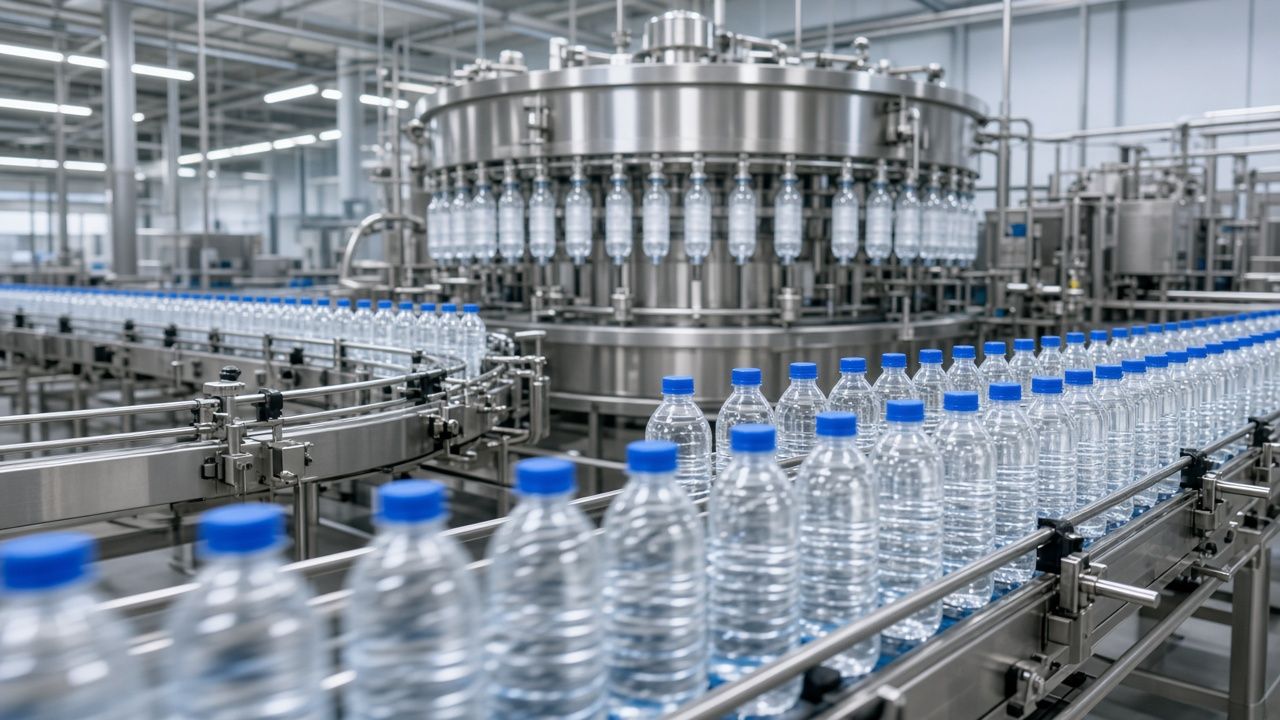
BPH Definition: Bottles Per Hour
BPH stands for bottles per hour. It is a unit of measure for how many bottles or containers a line processes per hour, with the exact basis — what counts as "processed," and whether it includes filling, capping, or downstream steps — depending on the line configuration, product, and supplier specification.
When a supplier quotes a line at a given BPH, they are describing an hourly rate, not a guaranteed daily production volume. In my experience commissioning filling lines, most capacity disputes between buyers and suppliers start right here: one side reads BPH as a promise of shipped product, the other side meant a machine design speed.
How BPH Expresses Bottling Line Capacity
BPH is one common way bottling equipment is sized and compared. Other lines are also described in units such as containers per minute (CPM) or cases per hour, depending on the market and product. Converting between them is simple arithmetic, but you must know the pack size:
- BPH = CPM × 60
- Cases per hour = BPH ÷ bottles per case
- Litres per hour = BPH × fill volume (L)
Illustrative example: a filler running at 100 CPM equals 6,000 BPH. Packed in 24-bottle cases, that is 250 cases per hour; at 0.5 L per bottle, it is 3,000 L of product per hour. The litres figure matters when you size water treatment, syrup preparation or CIP utilities, because those systems must keep up with the filler, not with the case packer.
What Affects BPH
- Bottle Format and Volume — a 500 ml PET bottle and a 5-gallon jug run at very different rates.
- Product Type — carbonated, still, hot-fill, or viscous products fill at different speeds.
- Fill Technology and Head Count — adding filling valves can increase a line's potential throughput, but the realized rate is also limited by upstream supply, downstream packaging, and operating conditions.
- Changeovers — switching bottle sizes or products stops the line and lowers effective hourly output over a day.
- Container Handling — lightweight PET, unstable shapes and tall glass bottles may need slower conveyors and gentler transfers to avoid jams and tip-overs.
- Line Balance — the slowest machine sets the pace. A well-designed line runs downstream machines slightly faster than the filler so accumulation can absorb short stops.
For a rotary filler, a useful first-order check is: Theoretical BPH ≈ number of fill valves × 3,600 ÷ fill-cycle time per valve (seconds), where the cycle includes filling, pre/post-evacuation or settling, and the non-filling portion of the carousel rotation. Illustrative example: 24 valves with an effective 9-second cycle gives roughly 24 × 3,600 ÷ 9 = 9,600 BPH theoretical. That is a ceiling for the filler alone, before any losses.
Gross / Nameplate / Rated vs Net / Actual Output
- Nameplate or rated capacity — theoretical maximum under ideal, continuous running.
- Net or actual output — what the line really produces after stops, changeovers, cleaning, and rejects.
Nameplate capacity is a design reference, not a guarantee of what you will ship. For a full breakdown of the losses between the two, read our guide to gross vs net production capacity.
Why Your Quote Must State the Capacity Basis
Two suppliers can both quote the same BPH and mean different things. A supplier should clearly state whether the quoted BPH refers to nameplate capacity, rated capacity, or expected net output.
We do not assume a single industry-standard BPH basis exists, and we do not present nameplate figures as guaranteed production. A quote should also say which bottle size, which product and which machine the figure refers to — a "12,000 BPH line" quoted on 330 ml water may run far slower on 1.5 L carbonated soft drink.
BPH Is a Rate, Not a Daily Total
BPH × operating hours ≠ daily output, because the line does not run at the quoted rate for every hour. A more realistic planning formula is:
Net daily output = Rated BPH × Planned production hours × OEE
Illustrative example (assumed figures, not a guarantee for any specific line): a line rated at 8,000 BPH, scheduled for two 8-hour shifts (16 hours), with an assumed OEE of 65%, gives 8,000 × 16 × 0.65 = 83,200 good bottles per day — not the 128,000 that simple multiplication suggests. Your own OEE must come from measurement or a well-reasoned estimate for your product and schedule.
When to Use a BPH Calculator
Use a BPH calculator when you know your target volume and need to size the line, or when you want to compare quotes on a common basis. To size backwards from demand, rearrange the formula:
Required rated BPH = Target good bottles per day ÷ (Planned hours × expected OEE)
Illustrative example: to ship 60,000 good bottles per day over 16 planned hours at an assumed 60% OEE, you need 60,000 ÷ (16 × 0.60) ≈ 6,250 BPH rated. Most engineers would then round up to the next standard machine size and allow headroom for market growth, rather than buy a line that only works if everything goes right.
BPH, OEE, Downtime, CIP and Changeover
BPH describes a rate. OEE (Overall Equipment Effectiveness) = Availability × Performance × Quality.
- Availability = run time ÷ planned production time. It is reduced by breakdowns, changeovers and waiting for materials.
- Performance = (bottles produced ÷ run time) ÷ rated BPH. It is reduced by minor stops and running below rated speed.
- Quality = good bottles ÷ bottles produced. It is reduced by underfills, cap defects, label faults and start-up rejects.
Illustrative example: availability 85% × performance 90% × quality 98% = OEE of about 75%. Each factor looks respectable on its own, yet together they remove a quarter of the theoretical output.
- CIP consumes scheduled production time.
- Changeover reduces available hours.
- Unplanned downtime lowers availability and output.
Whether CIP and planned maintenance are counted inside OEE or excluded from "planned production time" varies between plants. Agree the definition before you compare figures.
Common Buyer Mistakes with BPH
- Multiplying BPH by 24 hours. No line runs at rated speed around the clock; cleaning, changeovers and maintenance all take time.
- Comparing quotes on different bottle sizes. A BPH figure is only meaningful for a stated container and product.
- Sizing only the filler. Blow moulders, labellers, shrink wrappers and palletizers must be balanced to the filler, or the slowest machine becomes your real BPH.
- Ignoring utilities. Water treatment, compressed air and product preparation must supply the line at its peak rate.
- Buying with zero headroom. A line sized exactly to today's demand has no room for growth, new formats or a bad week.
RFQ Specification Tips
When you request quotes, give suppliers the same inputs and ask for the same outputs:
- container type, material, volume and dimensions for every format;
- product type (still, carbonated, hot-fill, viscous) and fill temperature;
- target good bottles per day and planned operating hours;
- number of formats and expected changeovers per week;
- rated BPH per format, and which machine is the bottleneck;
- expected net output, with the assumptions stated in writing;
- how acceptance (factory and site testing) will measure speed.
iBottling has supplied bottling equipment since 1995 to customers in more than 150 export countries, from a factory certified to ISO 9001 with CE-marked machines. We prefer quotes that state these assumptions clearly, because they protect both sides.
Frequently Asked Questions
Is BPH the same as CPM?
They measure the same thing on different time bases: BPH = CPM × 60.
Does a higher BPH always mean a better line?
No. A line that is oversized for your demand costs more, uses more floor space and may run inefficiently. Size to your realistic net requirement plus sensible headroom.
What OEE should I assume when sizing?
There is no universal figure. Use measured data from a comparable line if you have it; otherwise state a conservative assumption and make every supplier quote against the same number.
Does BPH change with bottle size?
Yes. Larger containers take longer to fill and handle, so the same machine usually has a lower BPH on larger formats. Ask for rated BPH per format.
How is BPH verified at acceptance?
Agree in the contract on the test duration, container, product and how stops and rejects are counted, then run the test at the factory and again on site.
Related iBottling Calculators and Equipment
- BPH / line cost calculator: BPH line cost calculator
- OEE and efficiency guide: OEE guide
- Water bottling equipment list: Equipment list
- Gross vs Net Production Capacity: Gross vs Net Production Capacity
- Water bottling solutions: Water bottling solutions
Next Step: Request a Quote
Ask each supplier to state the capacity basis explicitly, then contact us: Request a Quote.



