
Beverage Processing Systems
Stainless steel beverage processing systems for water treatment, syrup preparation, blending, pasteurization, and filtration. RO and UF water purification, temperature-controlled mixing and storage, tunnel and UHT sterilization. Each system is configured to match production capacity, source water quality, and finished beverage specifications.
Why Beverage Processing Systems
Beverage processing covers water treatment, ingredient preparation, blending, temperature control, and sterilization — the upstream stages that prepare liquids for filling. iBottling processing systems are designed for food-grade stainless steel construction, CIP compatibility, and integration with downstream filling and packaging equipment. System type — RO, UF, blending, pasteurization, or filtration — is selected based on source water quality, product formulation, and production volume.
Beverage Processing System Types
Select the right processing system for your beverage production. Each system type is configured based on source water quality, product formulation, and production capacity.
01
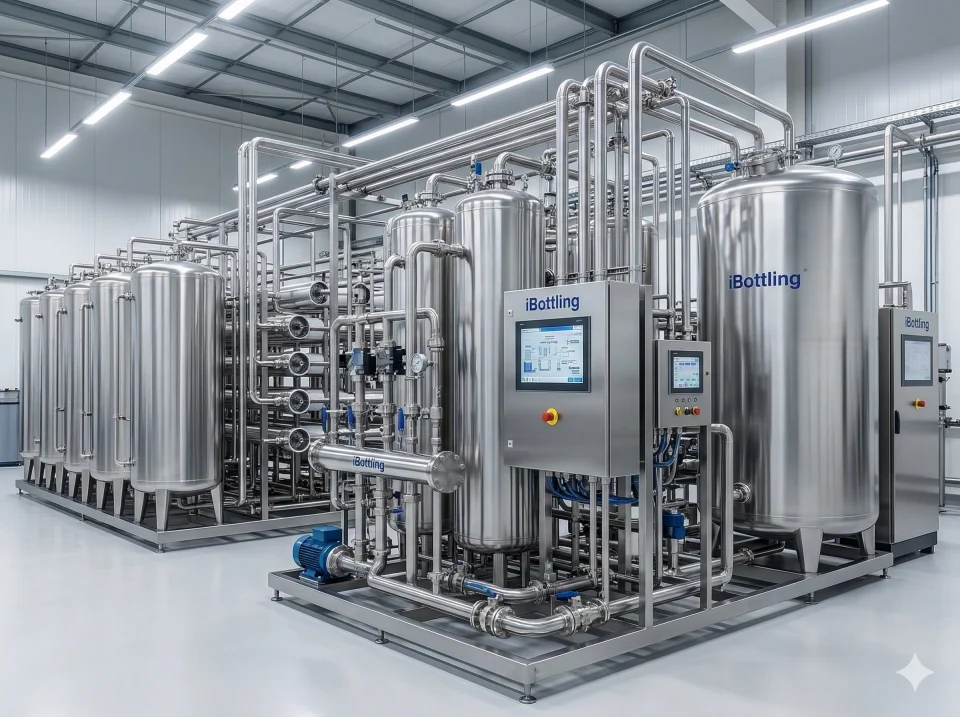
Water Treatment & Purification
Best for: Source water purification for bottled water, CSD, and juice production.
Technology: Reverse osmosis, ultrafiltration, seawater desalination. Multi-stage filtration.
Capacity: Project-configured — typical range 1–50 m³/hr depending on source water and production target.
Integration: Designed for hygienic operation and CIP integration options according to project requirements, PLC control panel, connection to blending or filling lines.
02
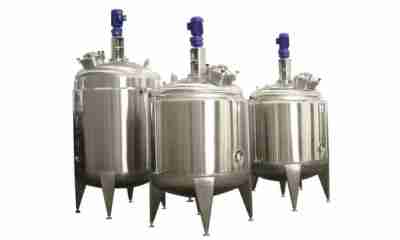
Syrup & Beverage Preparation
Best for: Syrup room operations, CSD concentrate preparation, juice blending.
Technology: Sugar melting tanks, stainless steel blending tanks with agitator mixing, sanitary aging tanks. Jacketed heating or cooling for temperature-controlled processing.
Capacity: Tank size configured to project requirements.
Integration: CIP-compatible design, temperature control, connects to carbonation and filling stages.

03
Temperature Control & Cooling
Best for: Process water chilling, ingredient cooling, blow molding mold cooling.
Technology: Air-cooled and water-cooled chillers, evaporative cooling towers, stainless steel plate heat exchangers.
Capacity: Refrigeration capacity configured to process requirements.
Integration: Energy-efficient compressor operation, multi-zone temperature control for coordinated processing line cooling.

04
Pasteurization & Sterilization
Best for: Shelf-life extension, microbial control for beer, juice, dairy, and isotonic beverages.
Technology: Multi-zone spray tunnel pasteurization (packaged product) and UHT tube sterilization (bulk liquid). Programmable temperature zones with controlled dwell time.
Capacity: Line speed and holding capacity configured to production target.
Integration: Stainless steel construction, automated CIP between batch changes, temperature monitoring and control according to process requirements.

05
Filtration & Separation
Best for: Pre-filtration, polishing filtration, and sterile filtration in beverage production lines.
Technology: Depth filtration (pre-filter), cartridge/polishing filtration, membrane separation (sterile).
Capacity: Flow rate configured to production line speed. Filtration stages with defined micron ratings.
Integration: Multi-stage filter configuration with automated backwash, hygienic stainless steel housings, CIP-compatible design for beverage-grade applications.
Related Processing Solutions
Processing systems integrate with complete beverage production lines. iBottling provides coordinated equipment supply from water treatment through to filling and packaging.
01
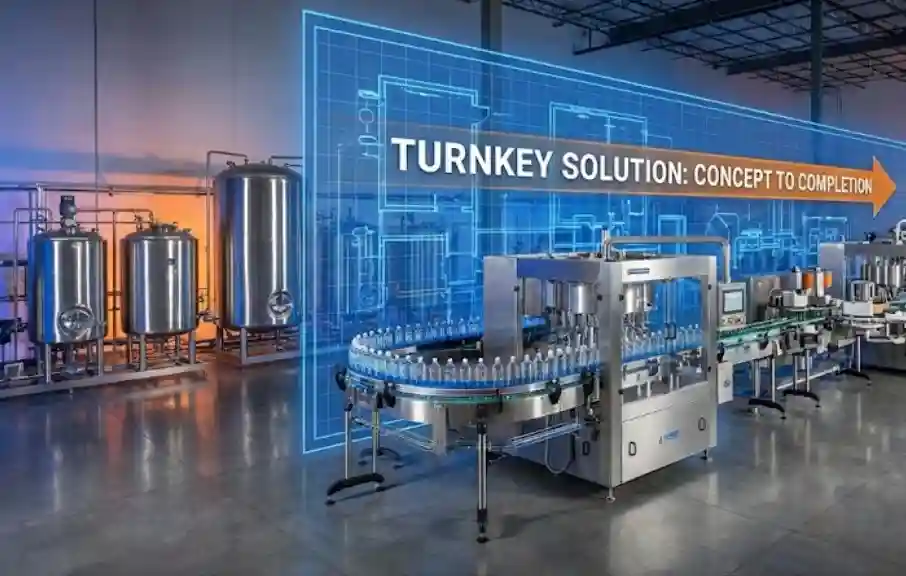
Complete Beverage Lines
Turn-key beverage production lines integrating processing, blow molding, filling, labeling, and packaging. Single-source responsibility from water treatment to finished pallet.
02
RO Water Treatment
Reverse osmosis systems configured for bottled water, CSD, and juice production. Multi-stage pre-treatment, membrane filtration, and CIP integration.

03
Hygienic Design & CIP Systems
Sanitary stainless steel construction and CIP (clean-in-place) integration for processing tanks, piping, and heat exchangers. Configurable cleaning cycles for beverage-grade hygiene compliance.
Processing System Selection Guide
Compare processing systems side by side. Select the right configuration based on your source water quality, product requirements, and production capacity.
| Selection Factor | Water Treatment | Syrup Preparation | Temperature Control | Pasteurization | Filtration |
|---|---|---|---|---|---|
| Primary function | Source water purification | Ingredient mixing and storage | Process cooling and heating | Microbial control, shelf life | Particulate and sterile filtration |
| Core technology | RO / UF / desalination | Jacketed tanks with agitators | Industrial chillers, cooling towers | Spray tunnel / UHT tube | Depth / cartridge / membrane |
| Typical capacity | Up to 50 m³/hr | Up to 20,000 L per batch | Up to 500 kW cooling | Up to 36,000 containers/hr | Up to 50 m³/hr |
| Key applications | Bottled water, CSD, juice | CSD syrup, juice blends, dairy | Filler cooling, mold cooling, ingredient | Beer, juice, dairy, isotonics | Pre-filtration, polishing, sterile |
| CIP compatible | Yes | Yes | Heat exchangers only | Yes (automated) | Yes (backwash) |
| Typical labor requirement | 1 operator per shift for monitoring and quality checks (varies by system configuration and automation level) | ||||
| Integration | Upstream of all processes | Between treatment and filling | Distributed throughout plant | After filling, before labeling | Positioned at process points |
| Best suited for | All beverage plants | CSD, juice, dairy producers | All production facilities | Beer, juice, dairy producers | Quality-sensitive production |
Actual output depends on source water quality, product specifications, system configuration, and site utility capacity. Contact our engineering team for project-specific recommendations.
Applications
iBottling processing systems are deployed across the full range of beverage categories — from bottled water through to carbonated drinks, juices, dairy beverages, and beer.
| Application | Key Processing Steps | Recommended Systems |
|---|---|---|
| Bottled Water | Filtration, RO/UF treatment, ozone sterilization | Water Treatment + Filtration |
| Carbonated Soft Drinks | Water treatment, syrup preparation, blending, carbonation | Water Treatment + Syrup Preparation |
| Juices & Functional Beverages | Blending, pasteurization, cooling | Syrup Preparation + Pasteurization + Temperature Control |
| Beer & Cider | Water treatment, pasteurization (tunnel), cooling | Water Treatment + Pasteurization + Temperature Control |
| Dairy & Isotonic Drinks | Mixing, UHT sterilization, aseptic storage | Syrup Preparation + Pasteurization (UHT) |
| Edible Oils | Filtration, blending, temperature control | Filtration + Syrup Preparation + Temperature Control |
| Energy Drinks | Water treatment, blending, pasteurization, cooling | Water Treatment + Syrup Preparation + Pasteurization + Temperature Control |
| Plant-Based Beverages | Filtration, blending, UHT sterilization, cooling | Filtration + Syrup Preparation + Pasteurization (UHT) + Temperature Control |
Processing Engineering & Support
Processing engineering from source water analysis to CIP-integrated processing and filling line connection. iBottling provides process design, P&ID development, equipment specification, on-site commissioning, and operator training for complete beverage processing lines.
Process Design & P&ID Development
Process design from production requirements: capacity planning, equipment selection, and P&ID (Piping & Instrumentation Diagram) development. Line layout drawings show equipment positions, pipe routing, valve schedules, and CIP circuit design for customer site preparation and installation.
Control System Coordination
PLC-based control and HMI solutions can be configured according to project requirements for equipment sequencing, temperature control, batching, and CIP operation monitoring. Control panel integration with filling line control system for coordinated production line operation configured per project requirements.
Installation, Commissioning & Training
On-site installation supervision by iBottling engineers — mechanical completion check, P&ID walk-down, step-by-step commissioning, and operator training. Post-commissioning support covers process parameter adjustment and production ramp-up to target throughput.
Processing Project Experience
iBottling processing equipment is deployed in beverage production lines across markets worldwide — from regional bottled water operations to fully integrated CSD and juice production.
01
Carbonated Drink Production Line — Russia
Complete carbonated beverage production line including PET bottle blowing, rinsing, filling, capping, labeling, and shrink wrapping. The customer completed installation independently using step-by-step guidance, with the line operating at target capacity since commissioning.

02
Bottled Water Production Line — Zimbabwe
Automated PET water bottling line serving the Lake Kariba region. Integrated blow molding, rinsing, filling, capping, labeling, and shrink wrapping. Designed for reliable operation with minimal on-site technical resources.
03
Turnkey Beverage Line Engineering
Project scope covers line layout design, equipment specification, FAT on customer containers, on-site installation supervision, and commissioning. Engineering support includes integration of water treatment, blow molding, filling, labeling, and packaging — coordinated as a single production system.
Frequently Asked Questions
Q1: What types of beverage processing systems does iBottling offer?
iBottling supplies water treatment systems (RO, UF, desalination), syrup preparation systems (sugar melting, blending, aging tanks), temperature control equipment (chillers, cooling towers), pasteurization and sterilization systems (tunnel pasteurizers, UHT), and filtration systems for beverage production.
Q2: How much does a beverage processing system cost?
Processing system pricing depends on capacity, technology type, and system configuration. A basic RO water treatment system represents a different investment than a complete syrup preparation room with multiple blending and aging tanks. Contact our engineering team with your production requirements for a project-specific quotation.
Q3: How do I choose between RO and UF water treatment?
RO (reverse osmosis) removes dissolved solids and is suitable for bottled water and CSD production where low TDS water is required. UF (ultrafiltration) removes particulates and microorganisms while retaining minerals — suitable for mineral water and applications where some dissolved content is desired. Selection depends on source water quality and finished product specifications.
Q4: What is the difference between tunnel pasteurization and UHT sterilization?
Tunnel pasteurization exposes filled and sealed containers to controlled temperature zones as they move through a conveyor tunnel — commonly used for beer, juice, and carbonated drinks. UHT (ultra-high temperature) processing heats the liquid to 135-150°C briefly, then cools rapidly before aseptic filling — suitable for dairy, isotonics, and shelf-stable beverages. The choice depends on product heat sensitivity, packaging format, and target shelf life.
Q5: How many workers are needed to operate a processing system?
A well-automated processing system typically requires 1 operator per shift for monitoring and quality checks. The actual number depends on automation level, number of processing stages, and integration with downstream filling equipment. Semi-automated syrup rooms may require additional operators for ingredient handling.
Q6: What capacity range do your processing systems cover?
Water treatment systems handle up to 50 m3/hr of purified water output. Syrup preparation tanks range from 500 L to 20,000 L per batch. Pasteurization tunnels process up to 36,000 containers per hour. Each system is configured to match the required production capacity and can be paralleled for higher throughput.
Q7: Do you provide complete processing lines?
Yes. iBottling supplies integrated processing lines that combine water treatment, ingredient preparation, blending, pasteurization, and cooling into a single coordinated system. Processing equipment is designed for integration with downstream blow molding, filling, labeling, and packaging for a complete beverage production line.
Q8: What is CIP and do your systems support it?
CIP (clean-in-place) is an automated cleaning method that circulates cleaning solutions through processing equipment without disassembly. iBottling processing tanks, piping, and pasteurization systems can be configured with CIP-compatible sanitary connections and stainless steel construction. CIP system design is reviewed during project specification based on product type and hygiene requirements.
Q9: What level of automation is available?
Automation ranges from basic PLC control with manual valve operation to fully automated processing lines with SCADA integration, automated CIP cycles, temperature and flow monitoring, and recipe-based batch control. The appropriate level is determined by production volume, product complexity, and quality control requirements.
Q10: What are the ROI factors for an automated processing system?
Key ROI factors include water and ingredient savings through precise batching, labor reduction from automated CIP and process control, reduced product waste from consistent quality, and improved shelf life from controlled pasteurization. Payback period depends on production volume, existing equipment efficiency, and local utility costs.
Q11: Can processing systems handle multiple product types?
Yes. Processing systems are configured for multi-product flexibility. Blending tanks can be dedicated per product or shared with CIP between batches. Filtration and water treatment systems are product-independent and serve the entire line. Product-specific configurations are reviewed during the specification phase.
Q12: What maintenance does a processing system require?
Regular maintenance includes RO membrane cleaning and periodic replacement, inspection of tank agitator seals and gaskets, heat exchanger descaling, pasteurization tunnel temperature calibration, and filter element replacement. A preventive maintenance schedule is provided with each system, with spare parts support for continued operation.
Q13: How long does processing system installation take?
Installation time depends on system complexity. An RO water treatment system typically requires 1-2 weeks for installation and commissioning. A complete processing line with syrup preparation, blending, pasteurization, and CIP may require 4-6 weeks on-site. Our team provides installation supervision and operator training during commissioning.
Q14: Do you provide spare parts and technical support for processing equipment?
Yes. iBottling provides standard warranty coverage on all processing equipment with extended coverage options available. After-sales support includes technical documentation, remote troubleshooting, spare parts supply for common wear components (RO membranes, seals, gaskets, filter elements), and on-site service as required.
Q15: Can I expand processing capacity later?
Capacity expansion is possible with most iBottling processing systems. Options may include adding additional RO membrane elements, paralleling treatment skids, adding blending tanks, or increasing pasteurization tunnel length. Discuss future capacity requirements during specification so the system layout can accommodate expansion.
Get Your Processing Solution
Describe your production requirements, source water quality, beverage type, and target capacity. Our team will recommend the right processing configuration.
