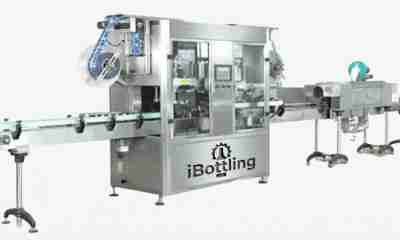
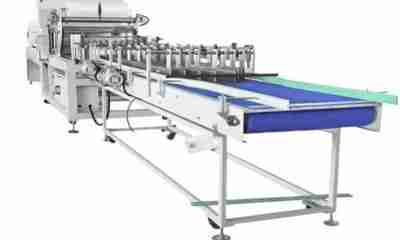
Bottle control
Stable bottle handling keeps the label event centered through the line.
Pressure-sensitive labeling systems
Pressure-sensitive bottle labeling for projects where label placement, liner behavior, sensor timing, and wipe-down contact have to stay stable across real production changeovers, not just sample runs.
Since 1995 · CE & ISO 9001 · 150+ countries
Built for beverage packaging project teams
A pressure-sensitive labeling line only performs well when bottle spacing, sensing, web tension, peel-plate geometry, wipe-down pressure, and discharge control are engineered as one system. Domestic benchmark configurations publish compact units at 60-120 bottles/min and rotary platforms at 12,000-24,000 BPH, but the final guarantee is still resolved against your bottle samples, label rolls, conveyor speed, and inspection scope before FAT.

 Bottle Sample FAT
 Label Roll Validation
 PLC/HMI Recipe Backup
 Commissioning Support Plan
This adhesive platform is organized around one fragile moment: the label leaves its liner, meets the bottle in the right window, and stays visually square without wasting stock or slowing the line.
Roll feed, peel plate, and applicator position are arranged so operators can see and correct the web path quickly.
Guides, side belts, and conveyor timing keep the label target steady through application.
Roll changes, sensor adjustment, and applicator access stay within the operator's working zone.
Bottle control
Stable bottle handling keeps the label event centered through the line.
Label transfer
Accurate placement comes from trigger timing and applicator geometry.
Changeover
Fast service access keeps roll changes and cleaning practical.
The labeling sequence is engineered as a single event: bottle spacing, label-web tension, product sensing, peel-plate transfer, wipe-down pressure, inspection access, and discharge flow are coordinated so the label lands cleanly and the line keeps moving. Upstream bottle control can be aligned with a PET bottle blowing machine , while downstream traceability and pack-out often connect to a laser coding machine and a shrink wrapping machine .


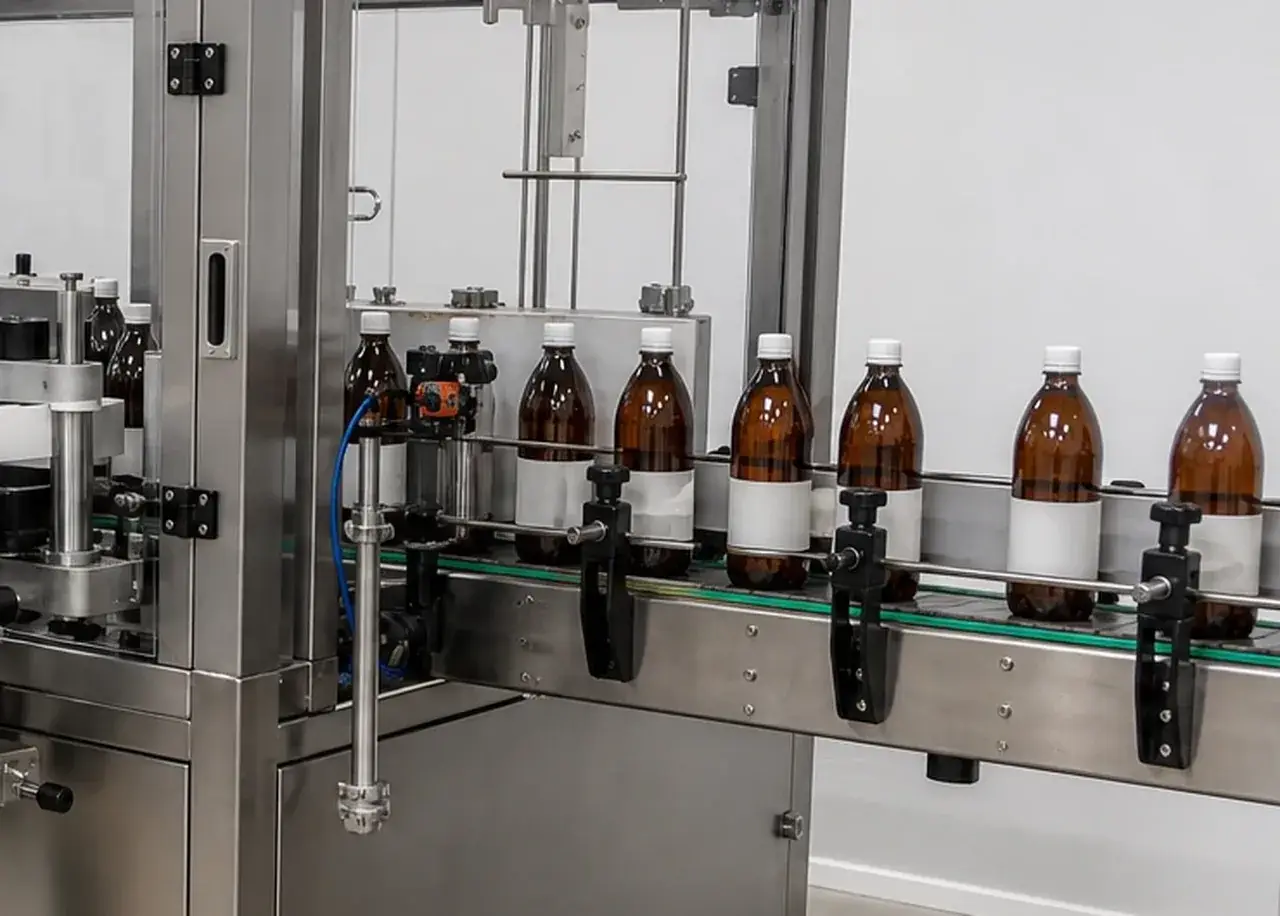
The quoted adhesive labeler file set ties CE declarations, guarding notes, label-stock checks, and bottle-sample acceptance records to the exact roll and container family reviewed during FAT, alongside the line interfaces typically shared with a laser coding machine and shrink wrapping equipment .
Pressure-sensitive projects depend on label-path discipline, so the BOM names the PLC, drives, sensors, peel-plate supports, wipe-down hardware, and reject devices that protect placement accuracy on adhesive stock.
| Item | Specification |
|---|---|
| Model series | Pressure-sensitive adhesive sticker labeling platform |
| Output range | Quoted after sample test: bottle stability, label length, conveyor speed, inspection/reject scope, and operator access |
| Container range | Round, flat, oval, and square bottles; diameter/height and side-panel flatness confirmed by drawing and sample |
| Label dimensions | Label width, label length, gap, backing liner, roll OD, and core size confirmed from label-roll data sheet |
| Placement tolerance | Guaranteed only after FAT using production bottle samples, production label rolls, and agreed inspection method |
| Label head | |
| Bottle handling | |
| Changeover | |
| Utilities and footprint | Power, air, conveyor height, roll-loading clearance, and guard footprint confirmed on GA drawing |
| Item | Standard | Servo | Front/back | Wrap-around | Orientation |
|---|---|---|---|---|---|
| Model series | Pressure-sensitive adhesive sticker labeling platform | ||||
| Output range | Quoted after sample test: bottle stability, label length, conveyor speed, inspection/reject scope, and operator access | ||||
| Container range | Round, flat, oval, and square bottles; diameter/height and side-panel flatness confirmed by drawing and sample | ||||
| Label dimensions | Label width, label length, gap, backing liner, roll OD, and core size confirmed from label-roll data sheet | ||||
| Placement tolerance | Guaranteed only after FAT using production bottle samples, production label rolls, and agreed inspection method | ||||
| Label head | Single head | Servo feed | Two-side heads | Wrap belt / roller set | Orientation sensor set |
| Bottle handling | Guide rail + conveyor | Servo-assisted timing | Side belts / stabilizers | Wrap-around roller set | Product orientation device |
| Changeover | Mechanical settings | Recipe + settings | Head spacing setup | Wrap belt / roller setup | Sensor and fixture setup |
| Utilities and footprint | Power, air, conveyor height, roll-loading clearance, and guard footprint confirmed on GA drawing | ||||
These layout references reserve roll-loading clearance, peel-plate service access, bottle stabilization length, and reject spacing around the adhesive station before the GA drawing is frozen.

Controlled unwind tension, peel-plate transfer, and wipe-down contact reduce missed labels, skewed placement, and liner breaks.
Roll access, web-path visibility, and saved recipes shorten recovery after label-roll change or bottle-family changeover.
Acceptance should prove more than throughput: the adhesive labeler has to show stable web tracking, square presentation on the bottle, readable sensor response, and repeatable restart behavior after reel and size changes.
Since 1995 · CE & ISO 9001 · 150+ countries

Complete beverage line engineering from treatment to packaging.
OEM-grade beverage lines — treatment, filling, blow molding, and packaging systems engineered for uptime, cleanability, and export commissioning.
HK: Chevalier House, 45-51 Chatham Road S.
Shanghai: Hope Business Bldg, No. 655, Fengzhou Rd.
Shenzhen: Overseas Friendship Bldg, No. 12 Yingchun Rd.
+86 (755) 8314-3479