



PET stretch blow · Two-stage rotary & linear builds

Automatic PET Blow Molding.

High-speed PET stretch-blow solutions for still water, CSD, and hot-fill routes— up to 8 cavities and 2,000–11,000 bottles/h at 500 ml on the published envelope, with FAT/SAT and line-integration support.

2,000–11,000bph @ 500 ml (source table)
Up to 8cavities

Get a Quote

Since 1995 · CE & ISO 9001 · 150+ countries

Engineering & Delivery Highlights

STRETCH BLOW PROCESSHIGH-PRESSURE AIR TRAINFAT / SAT COMMISSIONINGCE CertificationISO 9001:2015
CE CertifiedISO 9001:2015Global Field ServiceTwo-Year Warranty Scope (commercial terms)
Total cost of ownership

Built for PET line economics.

BMA-series stretch-blow platforms target stable neck quality, repeatable oven profiles, and lower recurring maintenance versus legacy island blowers—so operators spend more time in production and less time on unplanned stops.

Efficiency positioning (source page)
50%
Marketing claim on legacy page: “up to 50% improved efficiency” vs prior-generation framing—validate in commercial offer.
Maintenance & energy (source page)
25 / 20%
Legacy copy cites up to 25% reduced maintenance and up to 20% energy savings—binding improvement bands come from audit and baseline study.
High Speed Automatic PET Blow Molding Machine rated output equipment

Rated output — PET stretch blow

Throughput window (500 ml reference)
2,000 – 11,000 bottles / hour
Cavity count
Up to 8 cavities
Applications called out on source page
Non-carbonated water, CSD, hot-fill compatible PET (neck-dependent)
Satisfaction Guaranteed
2 Years Quality Warranty
Overseas Engineer Support Available
On Time Delivery Guaranteed

Two-stage blow science.

BMA-series machines stretch preforms in axial and hoop directions for better top load, clarity, and drop impact—while controlling oven profile and blowing pressure for repeatable bottle sets.

Oven & IR profile control

Zone-wise heating to condition preforms before high-pressure blow—critical for lightweighting and neck stability.

High-pressure blow control

Clean, dry air path with staged pressure build for consistent material distribution in the mold.

Changeover-ready tooling

Mold sets and neck-dependent change parts documented for FAT—SAT replay on site.

Operational Excellence.

50%

Source-page narrative on efficiency uplift vs prior-generation framing—subject to line audit and agreed baseline.

25%

Legacy marketing statement on reduced maintenance burden; PM kits and remote diagnostics per commercial terms.

20%

Energy positioning from legacy copy—final kWh/bottle verified on qualified builds during SAT.

The Core: Heat. Stretch-Blow. Discharge.

Two-stage PET lines condition preforms, stretch-blow in the mold, then discharge stable containers to airveyors or fillers—mirroring the legacy flow narrative (compressor → treatment → blower → output).

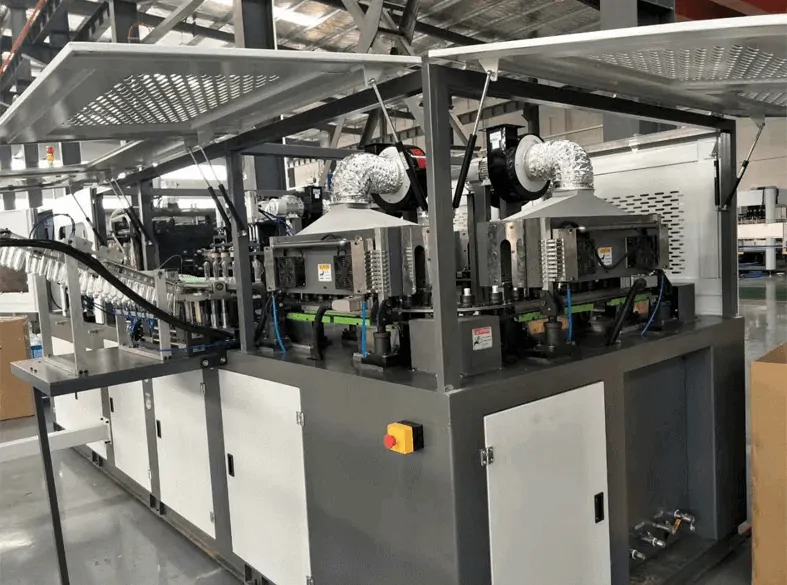
Infrared heating oven module of PET stretch-blow line conditioning preforms before blow station.

Preform heating

  • Multi-lamp oven zones profile neck and body independently where the configuration allows.
  • Stable thermal input reduces skew and variance before high-pressure blow.
  • Chilled water circuits to oven guards and mold bases per legacy cooling guidance—tie points on P&ID.
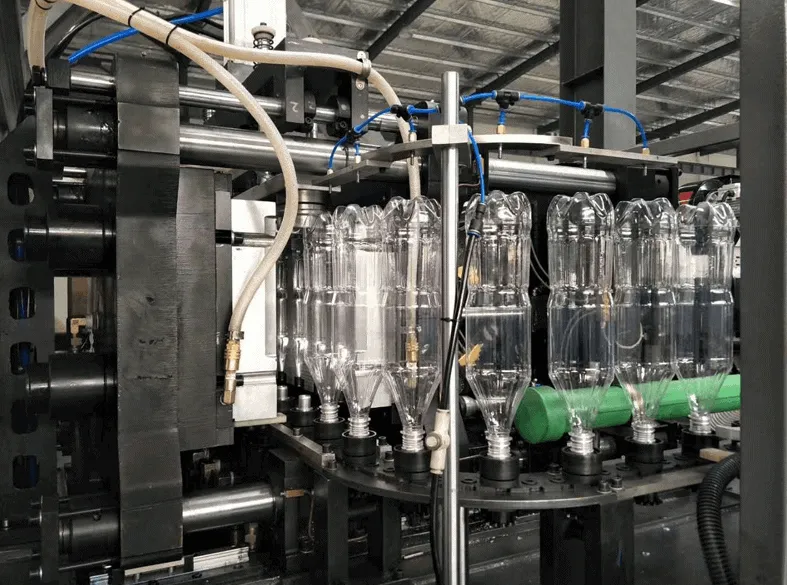
PET bottles inside blow mold station during stretch-blow forming.

Stretch-blow & clamping

  • Rod stretch plus high-pressure air pack to set final bottle geometry.
  • Clamping force sized to bottle projected area and blowing pressure—320 kN figure carried from legacy spec table.
  • Process air filtered and dried per legacy flow chart (compressor → tank → dryer → final filtration).
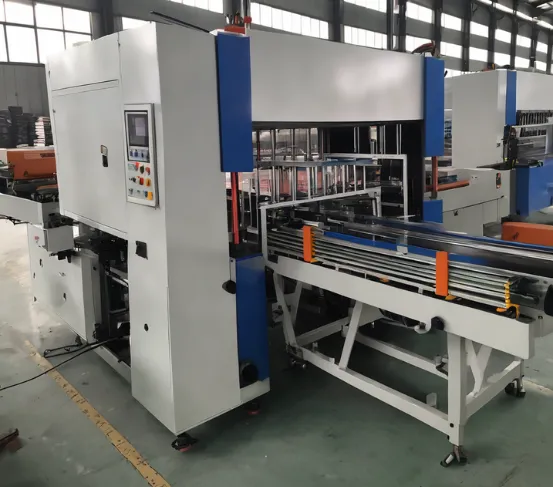
Internal mechanical structure of PET stretch-blow machine showing clamp, blow valve, and drive layout.

Discharge & line hand-off

  • Neck-led takeaway to air conveyor or direct filler coupling—alignment with downstream takt.
  • Defect detection interlocks optional per integration pack.
  • Legacy page cites up to 11,000 containers/h with eight cavities for high-volume still and CSD—confirm with neck drawing.

Technical Specifications.

2,000 – 11,000 bottles / h

500 ml reference · values transcribed from legacy Elementor price table

Compliance & Global Standards

  • ConformityCE Certified
  • Quality systemISO 9001:2015
  • Product safetyGuards, interlocks, and emergency stops per legacy safety FAQ
  • Customs referenceHS 8422301090 (from legacy structured data)

Declarations, drawings, and warranty scope ship with the project file set—quotation supersedes web figures.

Air & thermal subsystems

Subsystems called out on the legacy flow narrative—each sized in the integration BOM against bottle set, cavitation, and site utilities.

  • High-pressure compressor train Generates blowing air; staged filtration and buffering per legacy diagram.

  • Air treatment & storage Filters, desiccant dryer, and receiver to stabilise pressure and dew point before blow valves.

  • Oven & thermal regulation IR oven zones plus chilled-water circuits to molds and oven cooling channels per legacy cooling FAQ.

  • Mold & clamp assembly Clamping force and cavity pitch documented in GA; changeover kits per neck family.

ItemSpecification
Throughput @ 500 ml2,000 – 11,000 bottles / hour
Max container volume2 L
Max cavities8
Clamping force320 kN
Installed power (stated)120 kW
Footprint (L × W × H)3,600 × 2,000 × 2,210 mm

Plant Integration & Layouts.

Legacy module linked example PET CSD GA PDFs for 10,000 BPH and 2,000–3,000 BPH lines—use as reference downloads while the blow-molding GA is finalised for your bottle set.

5 gallon filling line equipment layout reference with monoblock and process flow arrangement
Material efficiency

Lightweight PET & lower resin per bottle.

Biaxial stretching

Improves mechanical properties so operators can target thinner walls within validated neck programs—legacy page cites roughly 10–15% material savings when lightweighting is executed correctly.

Energy-aware blowing

Oven profiling plus efficient air management reduce wasted cycles—SAT instrumentation proves out kWh per thousand bottles on qualified builds.

Process in motion.

Exported to 150+ Countries24/7 Rapid Response SupportTurnkey Engineering Services

Get a Quote for This Machine

Since 1995 · CE & ISO 9001 · 150+ countries

FAQ — PET stretch blow essentials

What chilled-water parameters does the legacy page recommend for molds?
The archived cooling FAQ suggests 10–12 °C supply, 0.3–0.5 MPa pressure, and roughly 40 L/min flow to support mold-base and oven cooling circuits—tune to your chiller skid and GA. Further reading: blow-molding-machine-cooling-system (Insights).
Which safety items were emphasised for operators?
Guards, door interlocks, emergency stops, verified electrical grounding, and lockout of pneumatic energy before maintenance—mirroring the legacy safety FAQ. Details: blow-molding-machine-safety-measures .
How do cooling towers support PET blowers?
Towers reject heat from the chilled-water loop so mold temperatures stay in band; legacy copy cites ~100 L/min tower-side flow for PET blow moulders. See benefits-of-cooling-towers-in-blow-molding .
What throughput and cavity count does the legacy spec table list?
2,000–11,000 bottles/h at 500 ml , up to 8 cavities , 2 L max volume, 320 kN clamping, 120 kW stated power, and 3,600 × 2,000 × 2,210 mm footprint—confirm on quotation.
Where can I read more on PET blow maintenance topics?
Lubrication cadence for chains and bearings was documented on the legacy page—see lubrication-tips-for-blow-molding-machines and pet-blowing-machine-parts on Insights.

What Is an Automatic PET Blow Molding Machine?

An automatic PET blow molding machine (also called a PET bottle blowing machine or stretch blow moulding machine) turns injection-molded PET preforms into finished bottles. Preforms are loaded, heated in an infrared oven, then stretched and blown with high-pressure air inside a mold until the PET takes the exact shape of the bottle. The finished bottles leave the machine ready for air conveying to the filler.

iBottling's BMA-series machines use the two-stage process: preforms are made first, then reheated and blown on a separate machine. This lets a bottling plant buy preforms or make them in-house, change bottle designs by changing molds, and run the blower directly in front of the filling line.

How the PET Blowing Process Works

  1. Preform feeding – preforms are sorted and fed neck-up into the machine automatically.
  2. Infrared heating – zone-wise oven heating conditions each preform to the right temperature profile. A correct profile is what makes lightweight bottles and stable necks possible.
  3. Stretching and blowing – a stretch rod stretches the preform axially while staged high-pressure air expands it in the hoop direction. Biaxial orientation gives the bottle its top load, clarity and drop resistance.
  4. Cooling and discharge – the mold is chilled so the bottle sets quickly; finished bottles are transferred out to the air conveyor.

Key Specifications (BMA Series)

ParameterValue
Throughput at 500 ml2,000 – 11,000 bottles/hour
Max cavities8
Max container volume2 L
Clamping force320 kN
Installed power (stated)120 kW
Footprint (L × W × H)3,600 × 2,000 × 2,210 mm

Final figures depend on bottle size, weight and cavity count, and are confirmed on the quotation.

Which Bottles Can It Blow?

  • Still and mineral water – lightweight PET bottles for high-volume water lines.
  • Carbonated soft drinks (CSD) – petaloid-base bottles that hold carbonation pressure, matched to CSD fillers such as our 12,000 B/H carbonated filling line.
  • Hot-fill juice and tea – heat-set bottle designs for hot-fill routes (hot-fill blowing machines need the correct mold and process set-up, discussed at quotation stage).

How to Choose a PET Blowing Machine

  1. Match the filler speed. Size the blower slightly above the filler's rated output so the filler never waits for bottles.
  2. Decide the cavity count. More cavities mean more bottles per hour; choose based on bottle size and target output.
  3. List all bottle sizes. Each bottle shape needs its own mold set; planning sizes early keeps changeovers simple.
  4. Plan utilities. High-pressure air, chilled water for the molds and electrical power should be included in the plant layout from day one.
  5. Think about line integration. A blower placed directly in front of the filler (with air conveyor) saves storage space and avoids bottle contamination.

Why Source Your Blow Molding Machine from iBottling

  • Beverage equipment supplier since 1995, exporting to 150+ countries.
  • Factory certified to CE and ISO 9001.
  • One supplier for the whole line: blower, water treatment, filling, labeling and packaging, so bottle neck, mold and filler change parts are matched.
  • FAT before shipment and SAT on site, with installation and line-integration support.

Related Equipment

See the full blow molding machine range, complete water bottling lines, and the PET water filling machine that the blower feeds.

Request a quote for a PET blow molding machine → Tell us your bottle sizes, target output and preform weight, and we will recommend a cavity configuration.

Get A Custom Quote