

Abstract
To improve the efficiency of filling machines, a PLC-based servo system has been developed. This control system's heart is a programmable logic controller (PLC), which links to a user-friendly touchscreen MCGS via an Ethernet connection. The PLC then uses high-speed pulses from its motion function module FM357 to accurately regulate the nozzle's left-right and up-down movement. Through testing, it has become evident that this servo model offers superior accuracy and stability, enabling faster operation than ever in the food, pharmaceuticals and daily chemicals industries!
Keywords
filling machine; PLC; servo; stepping; MCGS; inverter; automation
The filling machine is used for packing beverages, food and other items. It is widely used in the industrial sector, such as food, medicine and daily necessities. The output level of the filling machine has an immediate effect on product quality and production efficiency. This begs for the servo-filling system to provide a higher accuracy control process and increased automation levels so that it may continue to meet market demands.
In this article, we design a PLC-based automated servo-filling machine control system which uses PLC as its core controller, thus providing superb stability and reliability; further utilising the servomotor's high accuracy positioning function along with MCGS touch screen simple yet flexible visual operation interface allows real-time display of the running condition hence promoting greater precision within automatic operations across industries like food, medication or even daily commodities.
System Architecture
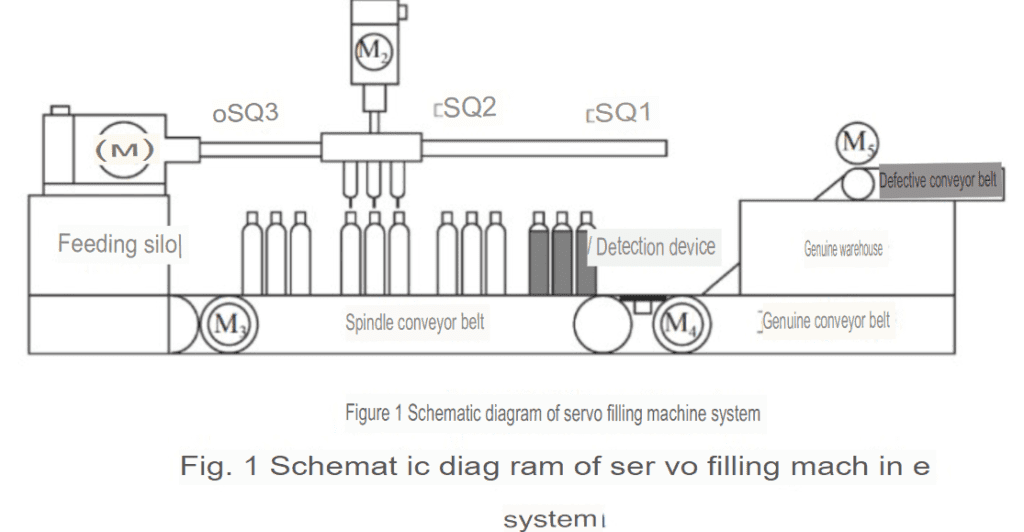
The Servo Filling Machine System comprises an X-axis servo, a Y-axis stepper filling, a central shaft conveyor belt, a detection device for qualified products, and another conveyor belt for inferior products (as shown in Figure 1). The nozzle used to fill the containers must be moved left or right while tracking materials and up or down to achieve filling.
Servo motor M1 drives the X-axis and follows the material bottle, controlling the left and right movement of the filling platform; Stepper motor M2 drives Y-axis to move up and down for filling purposes. Variable frequency drive controls three-phase asynchronous motors M3 to adjust speed, driving conveyor belt running. After passing through the inspection device after completion of packing, it is divided into qualified product packing and substandard product packaging, respectively, driven by respective three-phase asynchronous motors M4 and M5 with conveyor belts.
System Design
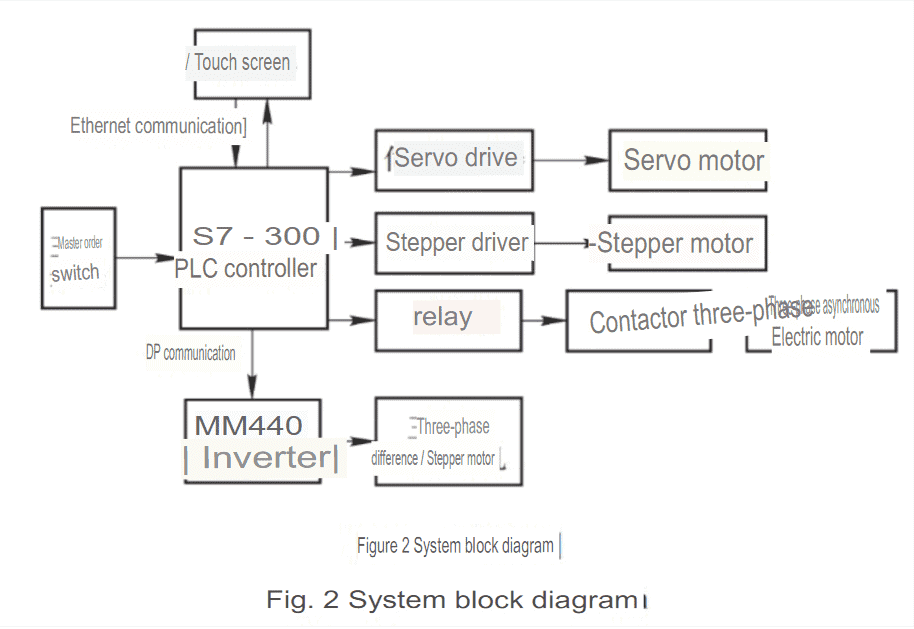
As shown in Figure 2, a system control diagram is employed. According to the system control requirements, the Siemens S 7-300PLC+FM357-2 motion control module is chosen as the core plc based controller, and Kunlun Tong MCGS touchscreen serves as its human interface.
Ethernet communication method is utilized between PLCs while frequency converter Siemens MM440 enables adjusting speed for spindle conveyor belt by receiving instructions from PLC through DP communication. The Servo motor controls nozzle movement, tracking material bottle while the stepper motor manages the nozzle’s upward and downward activities; three-phase asynchronous motors are responsible for maintaining main shaft conveyor belts, defect-free conveyor belts, and defective part conveying bands, respectively.
System design function
The system features two operational modes, Debugging and Automation. Users can select either of these modes according to their respective privileges by touching the screen after powering up. The person in charge must enter a password before entering the debugging interface, where they are allowed to debug all five electric motors within the system. Upon correctly inputting their passwords, operators will be granted access to an automation mode from which they can efficiently operate the entire system.
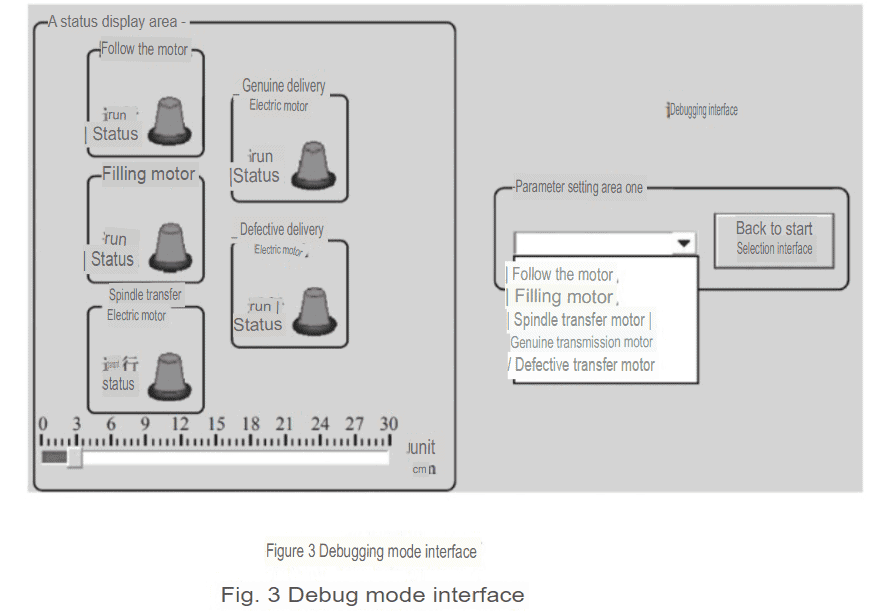
(1)Debug mode
Upon entry into Debugging Mode by the personnel in charge, the touchscreen will reveal a debugging interface similar to Figure 3. The user can then select any desired motor to debug via the drop-down box and observe that its corresponding indicator lights up before performing operations on the said motor by the requested assignments.
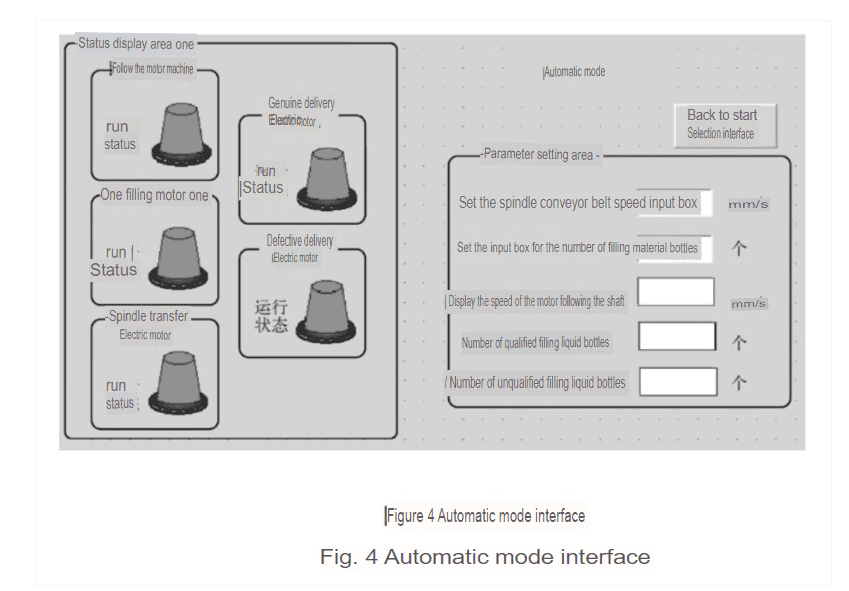
(2)Automatic mode
When the "automatic mode" is selected, the touch screen will enter an automatic mode interface, as shown in Figure 4. The central axis conveyor belt speed, and number of filled material bottles can be set through the touch screen. When the start button is pressed and feed sensor SQ3 initially detects that empty material bottles are entering the main axis conveyor belt, the central axle conveyor belt rotates with the empty material bottle, while X-axis follows servo motor M1 to run to SQ2.
At this time, the filling nozzle catches up with an empty material bottle and then synchronizes with a conveying belt at the same speed towards the SQ1 position. Within synchronous intervals, the filling nozzle moves downward to fill liquid into a container when electric motorM1 runs to the locationSQ1, finishing liquid injection.
M1 motor runs at high speed of 3 r/s to SQ2, then fills the next empty material bottle with liquid. Meanwhile, the qualified detector starts detecting certified bottles and displays their qualification on the touchscreen - whether they are acceptable. If accepted, it activates the M4 conveyor belt drive motor, which runs for 5 seconds before stopping; otherwise, the mechanical arm grasps onto the secondary transfer band while its electric machine M5 boots up and operates for 5 seconds before halting. This process goes in cycles accordingly.
When the system is running automatically, and the Stop button is pressed, it will complete filling up this material bottle before stopping. Throughout its operation, the touchscreen can display important information about the electric motors' work status indication light, follow-up speed of shafts, number of bottles filled qualified or unqualified etc.
In case of an emergency situation arises, press the Emergency Stop button to stop immediately. After recovery from emergency mode, if Start Button is pressed again, the system will start from the previous state itself.When liquid detection sensor does not detect any liquid in the tank, the alarm screen with the message "Storage Tank has no Liquid please add Liquid" pops out automatically on Touchscreen; Once the Signal is detected by Sensor Alarm Screen Automatically disappears.
System Design
4.1 Ethernet communication design between PLC and touchscreen
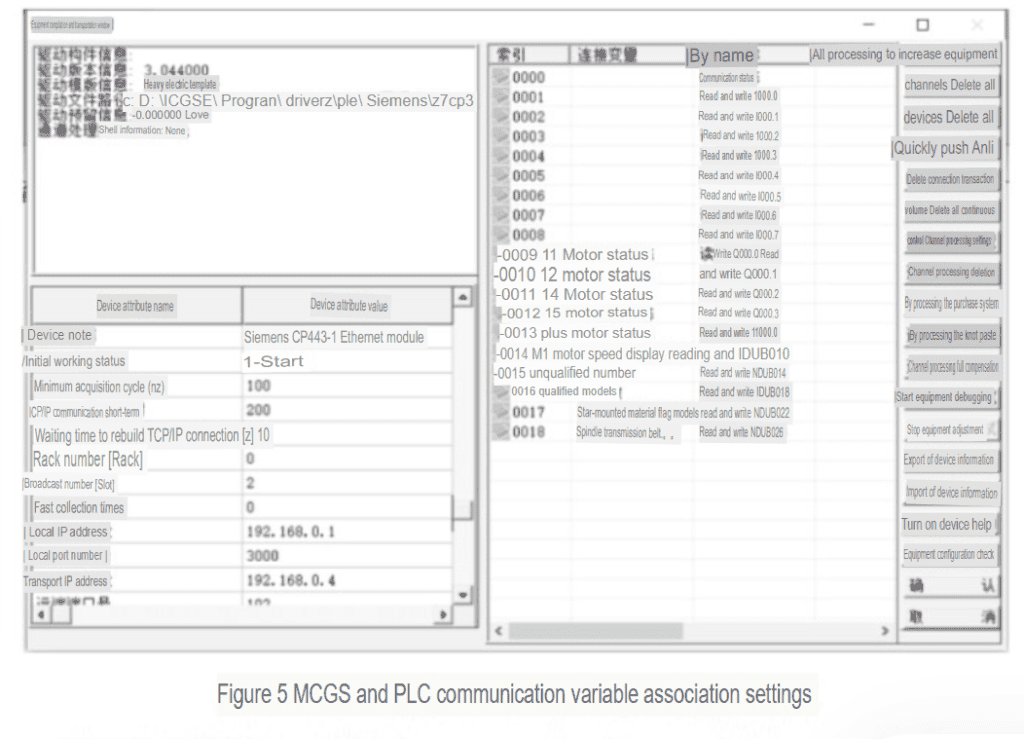
The S7-300 touchscreen and the MCGS communicate via Ethernet, allowing you to configure both in the MCGS. To do this, add a TCP/IP device and a Siemens CP443-1 Ethernet module to your Device Window of the MCGS software; then set up PLCs' IP address and that of Mcgs'.
The system requires the touchscreen to read from PLC's motors status running, spray piping axis moving speed, qualified number and total number during the bottle filler packing process; moreover, it will also write signals such as primary shaft conveyor belt speed setting, packed material bottles processing amount setting or motor selection on debug mode under current drop menu bar into PLC.
First, draw out the desired components in MCGS and set up variables inside a database before assigning each variable to its corresponding element. At the same time, configure all of the communication channels needed for Ethernet modules and connect these with the related variables from MCGS; once complete (as seen in Figure 5-6), the setup is finished.
4.2 DP communication between PLC and inverter
The S7-300 and MM440 inverters utilize PROFIBUS-DP communication, allowing the PLC to operate them to effectively control the electric motor of the main spindle conveyor according to predetermined objectives.
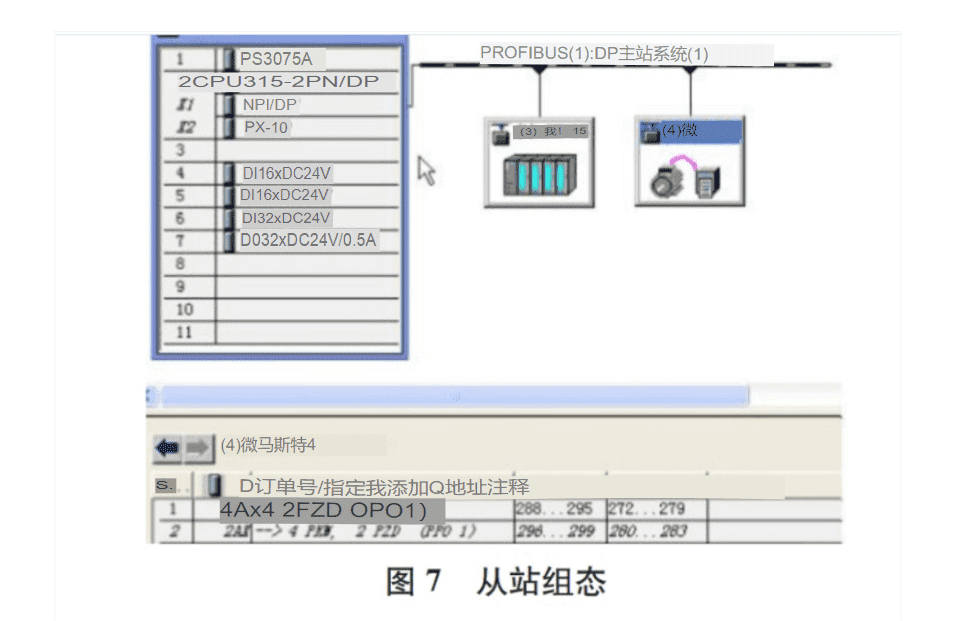
Configure the slave station in the PLC
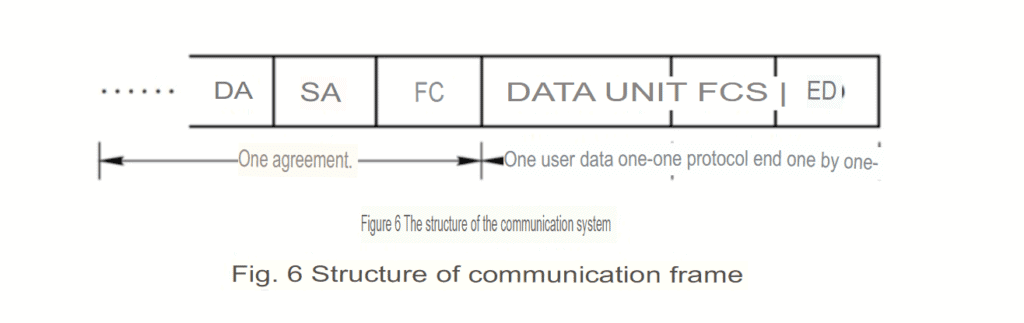
Connect the MM440 to the DP bus and configure its communication region. The MM440 uses a universal serial interface protocol, as illustrated in Figure 6. It also utilizes the user data structure of type PPO1, which contains 4-word PKW data and 2-word PZD data.
MM440's corresponding read/write addresses are PKW and PZD, with IB288-295 for writing PKW, IB296-299 for writing PZD, QB272-279 for reading PKW and QB280-283for reading PZD. The station configuration can be seen in Figure 7 as shown.
To make programming more accessible, a static memory space known as DB1 can store the data for S 7-300 and MM440 that needs to be read and written. This data block is similar in structure to PKW and PZD, with separate reading/writing regions from .
Inverter parameter setting
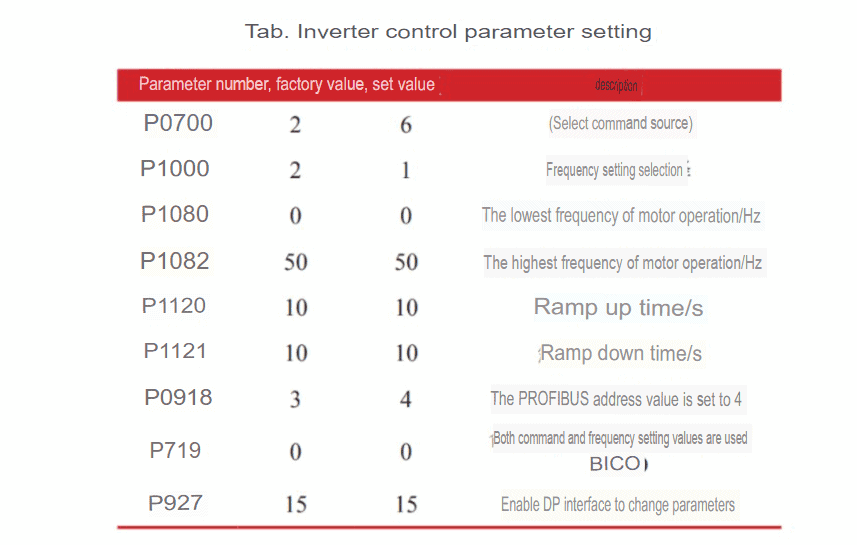
After completing the PLC communication setup, parameters must be set for the frequency converter. This includes control and communication settings, as shown in the table below.
Wrapping up
The system is designed to power a servo filling machine. The S7-300 PLC and touchscreen communicate through Ethernet, while the S7-300 and MM440 inverters utilize PROFIBUS-DP communication. With careful setup in MCGS, the PLC can read different parameters from electric motors and write signals onto them with commands from the touchscreen. This system allows users to conveniently operate and monitor the servo-filling machine easily.
With decades of experience in manufacturing beverage bottle filling machines, beverage fillers and other packaging equipment, iBottling guarantees you a streamlined and high-quality product. Our PLC-based servo machine is designed to meet your needs quickly and efficiently - get in touch today to discover more about our solutions!



