

With consumers' purchasing power increasing and market competition intensifying, high-speed and high-precision filling machines have become an inevitable trend for the filling industry – especially concerning industries like pharmaceuticals and cosmetics. However, most firms still rely on improving the process level of the production line/manufacturing level as well as employing manual adjustment techniques to enhance the accuracy of liquid packaging. Although this approach can achieve some results, it increases companies' operational costs while simultaneously raising the labor intensity, consequently lowering company productivity. The solution? A servo system that adjusts injector pump travel according to different set values to automatically fill liquids - a Liquid Filling Control System.
To address this issue, consider improving the control system of the existing production line to enhance its responsiveness or adding a filling station in place of manual adjustments to augment productivity. Conventional PID control is currently widely employed since it features a simple structure and is easy to implement. However, drawbacks such as insufficient stability, optimization capability, and inadequate self-adjusting capacity are still quite evident. For some nonlinear objects with apparent time lags, more than merely utilizing PID control will be required .
Many scholars have recently introduced advanced intelligent control algorithms into the bottling production line to enhance system control performance. iBottling designed an intelligent filling controller based on a high-speed filling model for small doses of high-speed liquid filler, aiming to improve the accuracy of the high-speed filling system and possessing the ability to overcome nonlinear influences from bottle characteristics. Furthermore, iBottling proposed a multi-motor bias coupling control method based on radial basis neural networks and PID control, which was applied in liquid packing production lines with more robust anti-interference capability and better coordination performance.
iBottling has developed a liquid micro-dosing system that is fast-responding, highly accurate, and resistant to interference. This paper further presents an intelligent filling system based on existing research that focuses on the issue of refilling during the process. Integrating cerebellar neural networks, PID control, and Kalman filtering techniques, this refill control algorithm was tested empirically and established effective in controlling micro-dosing systems.
01.
Filling production line
1.1 Basic structure
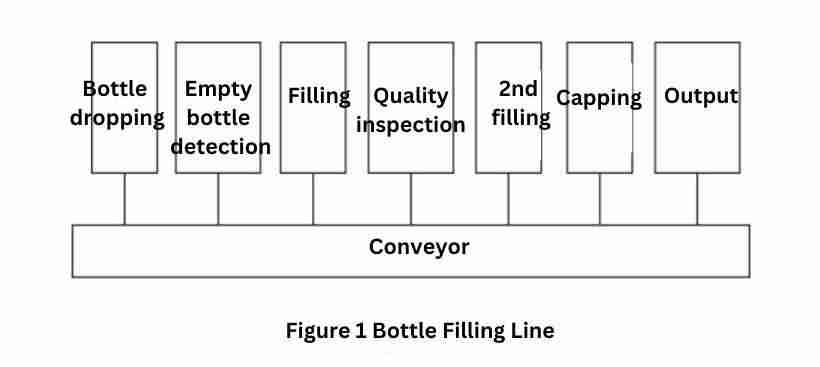
The typical filling line typically contains conveying, filling, capping, and finishing product output. Beyond these components, other steps, such as bottle inspection/testing and topping off, are also included. Figure 1 illustrates a schematic view of a typical filler production line (see below).
1)In the first step of a filling production line, known as conveying process, empty bottles are transferred from the transfer device to the conveyor belt. Generally speaking, such devices could be categorized into either rotary transferring or conveyor belts. They must ensure that each bottle is transported consecutively and accurately until it reaches its initial position on the belt, where an ejection mechanism will push them further along the chain.
2)The fill-up process is the core part of the filling production line. By utilizing sensors, it detects if an empty bottle has stopped below the fill-in port before stopping the conveyor belt and opening up the filler head for filling. Once finished with that step, after starting back up again, it will assess for any irregularities in quality during this stage - if significant discrepancies are detected, further supplementation on top-offs may be required.
3)At the capping station, the lid is pre-positioned and ready above. As soon as a bottle arrives at this workstation, the conveyor belt stops, and an elevating motor works together with a rotary engine for capping operations. Following that procedure, the conveyor belt restarts and transfers bottles to the next stage.
4)Once the final product has been tested and approved, a given amount of completed items are picked up by automated mechanisms and relocated to designated places. Additionally, to avoid quality issues with bottles, machines that utilize visual inspections evaluate empty containers for imperfections, such as cracks or dirt, before filling them; this ensures the overall product quality . From the analysis above, it is evident that packaging processes directly impact product quality – where Stage One loading constitutes coarse packing while reloading during stage two determines accuracy levels. The main focus of this article is micro-filling and explores ways to improve precision levels when doing so.
1.2 Analysis of filling characteristics
Whether it's bulk or micro-filling, the same factors broadly impact its filling processes, like the precision of the equipment machinery, temperature, air pressure, and liquid viscosity. Additionally, these influencing factors are not steady as they change with time and environment, making the entire filling procedure a typical nonlinear time-varying system. Defining an injection pump servo travel as u, then we can describe their relationship between filled volume to this servo travel accordingly:
V = λu + + δμε ( u,v,u ,T )+E (1)
The equation contains the linear coefficient λ between server journey and filling volume, a nonlinear time-varying function δ related to many factors such as servo travel u, filling speed v, liquid viscosity μ, and ambient temperature T, while ε stands for random disturbances that are caused by influencing elements. Liquid viscosity is associated with atmospheric pressure and liquid density, which can be expressed as:
μ = f (P, p) (2)
Within this equation, ρ represents the density of a liquid and p is the atmospheric pressure.
From Equations (1) and (2), it is clear that various factors affect the filling accuracy, which interferes with and influence each other. To simplify the control process, this paper takes actual filling quality as feedback quantity to get the quality deviation through comparison with set quality, then give it to the controller. The controller will drive the micro-filling system for secondary replenishment to improve filling accuracy. The micro-filling control system can be regarded as an independent system that separates from the central controller, effectively avoiding mutual interference .
02.
Filling production line
This paper combines small neural network control with conventional PID control, thereby designing a micro-filling system (Figure 2). To reduce noise and interference, we have opted for the Kalman filtering algorithm to filter out any disruption signals to enhance the stability and precision of our filling system.
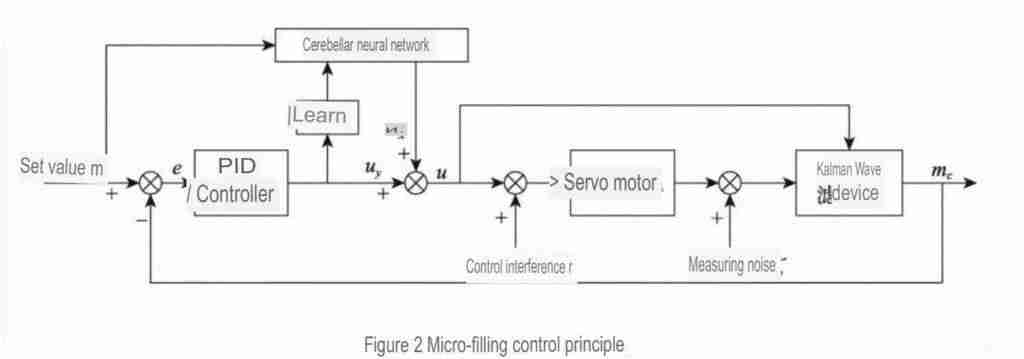
As illustrated in Figure 2, the value of filling quality is set as m. The output from the small brain neural network controller is xu; the production from the PID controller is yu, and the micro filling system's overall control quantity stands at u. Control disturbance and measurement noise are represented by τ & ζ, respectively. After processing through the Kalman filter, time-domain outputs mc could be estimated via overall control quantity, control disturbance, and measured noise.
2.1 Kalman filter
To maintain the system's stability and improve filling accuracy, controlling interference signals during the filling process is essential. Hence, we have utilized Kalman filters in this paper to eliminate noise and operation disturbance signals which are detrimental factors. Its principle can be summarized as follows:
Taking k as the time interval, let us consider the equation of state at this point:
x (K) =Ax (k) + Bu(K-1)+ τ(k) (3)
At time step k, the forecasting equation can be expressed as follows.: y ζ(k)= Cx(k)+ζ(k) (4)
Equations (3) and (4) demonstrate A as the status matrix, B as the control matrix, C as the output observation matrix, τ(k) representing a control disturbance signal at time k, and ζ(K ) being an observed noise signal at time k.
By equations (3) and (4), we can obtain the estimated value of the state equation, which is:
x ˆ(k) =A xˆ(K-1)+Bu(k -1) (5)
xˆ(k)=xˆ(k) + α(Yζ(k)- βxˆ (k)) (6)
If the goal is to minimize mean error, then the parameter updating equation can be expressed as xˆ (k-1) for prior state estimation; xˆ(k ) for posterior state estimation; α for gain state estimation; and β for measurement system matrix.
α(k) =P- (k)βT(βP-(K)βT+R)-1 (7)
P(k)=( I-α (k)β )P- (k ) (8)
P(k)=AP(k-1)AT+Q (9)
In this formula, P(k) represents the prior estimation of error variance; P(K)-represents the posterior estimate of error variance; R is a matrix representing measurement noise covariance; Q represents control interference covariance matrix, and I stands for identity matrix.
2.2 PID control algorithm of cerebellar neural network
By combining the small-brain neural network PID algorithm in this article to design a micro-filling control system, both forward and negative feedback controls can be employed. The output of the small-brain neural network controller is expressed as:

Let wi denote a neural network weight and c as a generalization parameter in the equation. The overall control quantity is then expressed as:

In the equation, ( ) y u k is the output of a PID controller. A tiny brain neural network weight update algorithm can be expressed as follows:
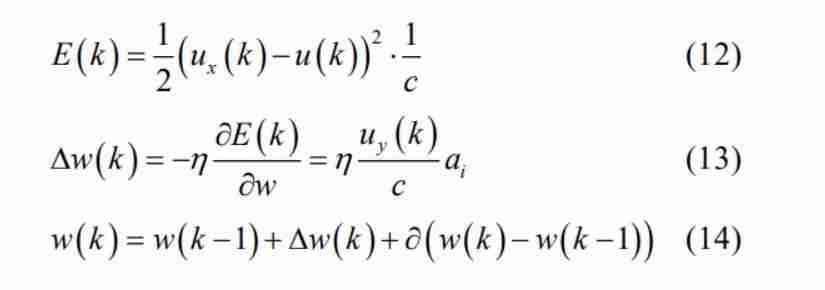
In equation E, k( ) is the weighted square error, η is the network learning rate, ∂ stands for inertia term, Δw k ( ) represents theoretical weighting errors, and w k( ) denotes weights obtained in iteration number k.
03.
Experimental research
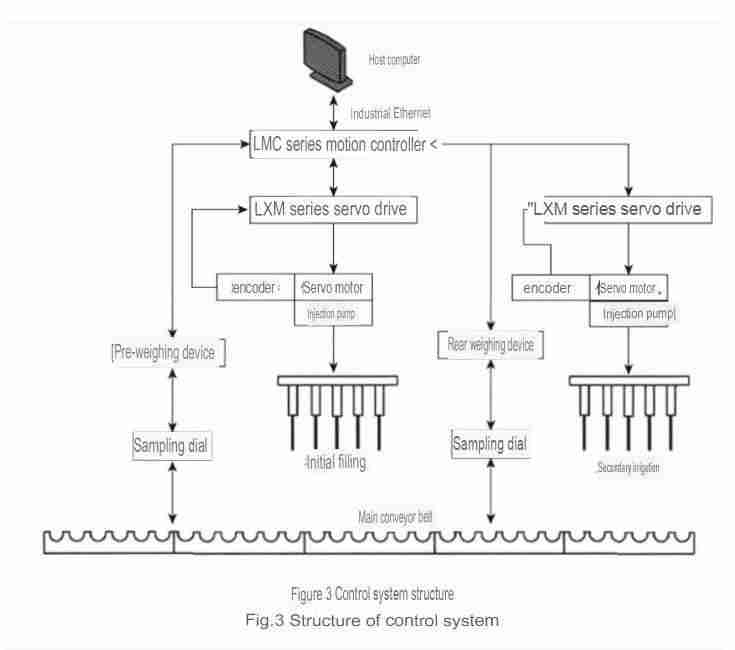
Experimental research is conducted in this article to validate the feasibility and effectiveness of the micro-volume filling control system. The injection liquid high-speed filling production line was chosen as the object for experiments. This filling control system mainly consists of a pre-metering device, a post-metering device, an LMC series motion controller, LXM Series servo drive and motor, upper computer monitoring system, etc., with a structure shown in Figure 3.
A precise amount of fluid can be dispensed using servo drives and servo motors during the filling process. Before this begins, an initial weight measurement is taken by a pre-weighing device to determine the mass of each empty bottle/container; afterward, another weighing apparatus captures how much has been filled into it before sending that data over to the motion controller - at which point calculations are made using said filling control algorithm to establish just what needs adjusting for accurate dispensation. As the heart of any given production line's operation, this vital unit will instantaneously interpret all pertinent information relating to such activities while conveying any prescribed modifications directly to those individual motorized pumps responsible for regulating output levels.
Connecting the host computer to the motion controller via Ethernet allows real-time production line operations to be monitored and process parameters set . As for the main technical parameters of the filling process: The central conveyor belt speed is 600 bottles/minute, the injector pump diameter is 15mm, the medicament density is 1 g/mL, the fill quantity is 10 mL, the suction back volume 0.5 mL, fill rate 100 mm/s, suction back rate 120 mm/s. After running continuously for 60 minutes on this production line of filling processes,100 randomly selected bottles were tested with a standard volume of 10ml and a weight being 10g, respectively.
By company requirements, the quality deviation was set to ±0.1 g, and the finished products were inspected to see if they met quality standards, as seen in Table 1 from some experimental data. It can be deduced from the experiment results that the maximum deviation is 0.09 g; furthermore, it has been found through statistics that no samples exceeded a 0.1 g difference which satisfied corporate demands. After initial filling, there were considerable discrepancies, yet after microfilming treatment, these deviances decreased significantly, improving accuracy—demonstrating that this system enhances precision when pouring liquids mentioned within this text. Additionally, during production, line operations ran stably quick and reliably, meeting high speed/accuracy needs perfectly well too!
Sample number | Empty bottle mass/g | Mass after initial filling/g | Mass after trace filling/g | Net drug mass/g | Standard mass/g | Deviation/g |
1 | 30.04 | 38.26 | 40.05 | 10.01 | 10.00 | 0.01 |
2 | 30.12 | 38.33 | 40.18 | 10.06 | 10.00 | 0.06 |
3 | 29.95 | 37.15 | 39.95 | 10.00 | 10.00 | 0.00 |
4 | 30.21 | 39.10 | 40.29 | 10.08 | 10.00 | 0.08 |
5 | 30.01 | 37.41 | 39.97 | 9.96 | 10.00 | −0.04 |
6 | 29.92 | 37.28 | 39.90 | 9.98 | 10.00 | −0.02 |
7 | 30.11 | 38.65 | 40.14 | 10.03 | 10.00 | 0.03 |
8 | 30.05 | 38.53 | 40.11 | 10.06 | 10.00 | 0.06 |
9 | 30.15 | 38.36 | 40.06 | 9.91 | 10.00 | −0.09 |
10 | 30.02 | 38.65 | 40.01 | 9.99 | 10.00 | −0.01 |
04.
Epilogue
To increase the accuracy of packing line filling, a micro-filling control system was designed in this paper to mainly apply to secondary filling processes. With neural network PID control and Kalman filtering, precision has been dramatically improved. The experimental results demonstrated that adopting such methods could significantly improve the accuracy of packing operations while ensuring reliability and stability under high-speed and highly accurate demand conditions. This proposed control system and method are valuable as it provides references but needs to explain the detailed interference effect from influencing factors; thus, further study should be conducted to enhance overall controlling accuracy even more.
It's time to get the most accurate and reliable filling machines on the market. With iBottling's intelligent filling systems, you can optimize your packaging production line and rest assured knowing that our precise servo drive and motor technology, upper computer monitoring system, advanced filling control algorithms, and more make for a perfect combination when it comes to highly efficient and accurate filling. Plus, our 24/7 customer support is here to help you every step of the way. Contact iBottling today to learn more about how you can take your packaging production line to the next level.
Let us help you revolutionize your production line now with iBottling intelligent filling systems!



