
5 Gallon Water Filling Line Cost
If you already know you want a 5-gallon (18.9L) returnable-bottle water filling line, the first question is almost always: how much does it cost, and what exactly is included in that price?
This page answers both — honestly. A 5-gallon returnable-bottle line is not a standard small-PET bottled-water line. The bottles come back, get washed, and go through a dedicated 18.9L monoblock; there is no blow molder in scope. That changes the equipment list, the washing scope, and the budget.
The figures on this page are example budget ranges, not quotations. They are based on Owner-supplied anonymized quotation references and configuration assumptions, and they illustrate the range and the factors. Final quotation depends on bottle condition, washing scope, automation level, packaging, conveyor length, Incoterm, and installation scope. A real figure only comes after we scope your plant.
This page is written for:
- Buyers who already sell (or plan to sell) 18.9L / 5-gallon returnable water.
- Plant owners replacing or expanding an existing returnable-bottle line.
- Procurement agents preparing an RFQ and first needing scope clarity.
- Distributors comparing full-line scope across OEMs.
Who this page is for
| Reader | What they need from this page |
|---|---|
| First-time 5-gallon buyer | What a complete returnable-bottle line is made of, and the realistic budget band. |
| Existing plant owner | What changes when scaling automation or adding washing/packaging scope. |
| RFQ preparer / agent | A configuration-assumption checklist to send us so the quote is accurate. |
| Emerging-market distributor | Why returned-bottle washing scope is a core cost, not an optional extra. |
Typical 5-gallon returnable-bottle line scope
- Decapper — removes and returns the caps from returned (refillable) bottles so they can be washed and reused.
- External bottle washer — washes the outside of returned bottles.
- Internal bottle washer — washes and rinses the inside of returned bottles (a returnable-bottle prerequisite, not optional fluff).
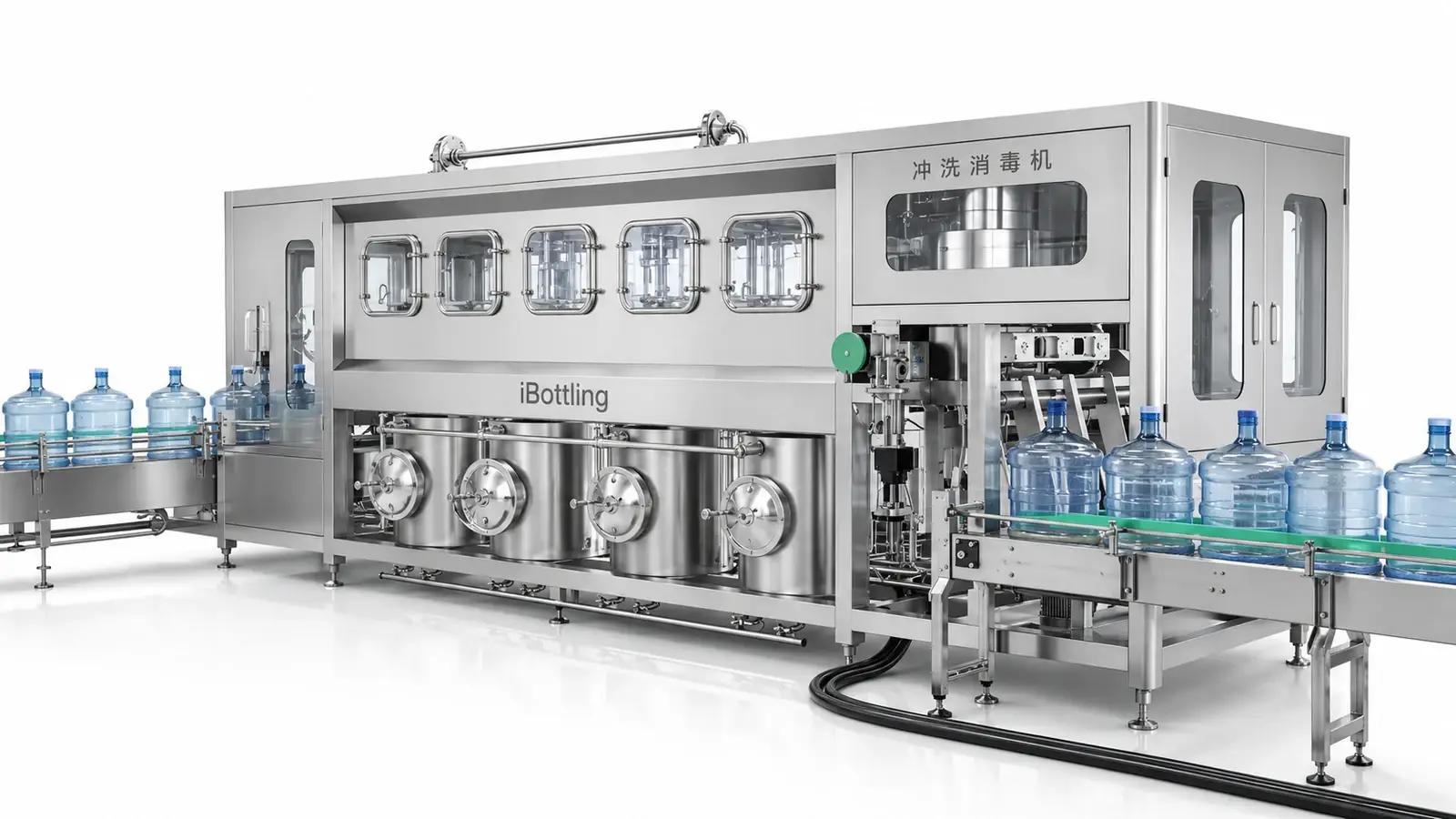
- Filling–capping monoblock — the core machine that rinses (final), fills, and caps 18.9L bottles.
- Cap feeder & cap sterilizer — orients, feeds, and sanitizes caps before capping.
- Labeling — applies the label/shrink sleeve to the 18.9L bottle or cap.
- (Optional) Bagging / sleeving — secondary protection for distribution.
- Conveyor system — moves bottles between stations; length is plant-layout dependent.
- Coding — batch/expiry date coding.
- Palletizer — stacks finished 5-gallon bottles for handling/shipping.
Note: a 5-gallon returnable line typically does not include a blow molder (the bottles are returned, not freshly blown). That is the single biggest scope difference from a small-PET bottled-water line.
Scope note: the station list above describes a typical returnable-bottle flow. Final equipment scope — which of these stations are included versus optional — depends on hygiene requirements, automation level, and plant layout, and is confirmed during quotation.
Equipment included (scope detail)
| Line component | Typical role in a 5-gallon returnable line |
|---|---|
| Decapper | Strips caps from returned bottles for reuse. |
| External washer | Cleans bottle exteriors before internal wash. |
| Internal washer | sanitizes bottle interiors — required for refillable bottles. |
| Filling–capping monoblock | Rinse-fill-cap in one integrated 18.9L machine. |
| Cap feeder & sterilizer | Cap orientation, feeding, and sanitizing. |
| Labeling | Label / sleeve application. |
| Bagging (optional) | Distribution protection — buyer-choice. |
| Conveyor | Inter-station transport; layout-dependent length. |
| Coding | Batch / expiry coding. |
| Palletizer | Finished-bottle stacking / handling. |
| Electrical & air-treatment | Controls, compressed air, treatment supporting the line. |
The core filler in this scope is iBottling's 5-gallon (18.9L) filling–capping machine, rated 3,000 BPH (a machine rating for the monoblock, not a full-line net-output promise), 12 filling heads, bottle classes 11L–25L (including 18.9L), with documented food-grade material construction. Applicable compliance certifications are confirmed during quotation against your target market. Line throughput depends on the surrounding equipment, not the monoblock alone.
Scope note: final equipment scope — which stations are included versus optional — depends on hygiene requirements, automation level, and plant layout, and is confirmed during quotation. Nothing in the table above is presented as an unconditional standard configuration.
Cost — example budget framework
PRICE POLICY (applies to every figure below). All figures shown are example budget ranges based on Owner-supplied anonymized quotation references and configuration assumptions. They are not a formal quotation. Final quotation depends on bottle condition, washing scope, automation level, packaging, conveyor length, Incoterm, and installation scope. Water treatment and installation are excluded from every line figure below unless separately quoted. No itemized per-station price is published on this page; the underlying quotation references are held in the evidence files and summarized only at the line level.
Example budget summary
| Reference line | Example budget range (USD) | Capacity | Incoterm | Excludes |
|---|---|---|---|---|
| Starter 5-gallon returnable line reference | around US$33,830 | 100–150 BPH (quoted configuration) | FOB China | water treatment · installation |
| Higher-automation 18.9L returnable line reference | around US$174,006 | 2,000 BPH recommended configuration | China export basis (final Incoterm confirmed during quotation) | water treatment · installation |
| Custom / expanded line | Quotation required (no figure stated) | depends on scope | confirmed during quotation | — |
Example budget range based on Owner-supplied anonymized quotation references and configuration assumptions.
Final quotation depends on bottle condition, washing scope, automation level, packaging, conveyor length, Incoterm, and installation scope.
How to read these numbers: each figure is an example anchor drawn from a real, anonymized, Owner-approved quotation reference — not a price list and not a guaranteed quote. The Starter reference reflects a low-automation returnable line; the Higher-automation reference reflects a higher-automation returnable line with extended washing and packaging scope. A line with different capacity, washing depth, conveyor length, water treatment, or installation scope is quoted individually.
What is included / excluded
| Item | In the example line figures? | Note |
|---|---|---|
| Decapper, external + internal washer, monoblock, cap feed/sterilize, labeling, conveyor, coding, palletizer, electrical/air | Yes (line scope) | Core full-line equipment; exact station mix confirmed during quotation. |
| Bagging / sleeving | Often included at Higher-automation tier; optional at Starter | Buyer-choice. |
| Water treatment | No — excluded | Not in either example figure. Quoted separately if in scope. |
| Installation / commissioning | No — excluded | Not in either example figure. Confirmed during quotation. |
| Blow molder | No | Returnable bottles are returned, not blown — out of scope by design. |
| Conveyor length beyond standard | Depends | Layout-dependent; long conveyors move the price. |
Why these are examples, not fixed prices
- Anonymized references, not case studies. The two example figures come from real quotation references supplied and approved by the Owner, with client names removed. They are shown to give a realistic budget band, not to advertise a specific project.
- Scope moves the price. Bottle condition (new vs returned), washing depth, automation level, packaging, conveyor length, Incoterm, and installation scope all shift the final number. The example figures assume the scope described in the typical line scope and equipment sections above.
- Machine rating ≠ line price. The 3,000 BPH figure is the monoblock machine rating only; the Higher-automation example line is anchored to a 2,000 BPH recommended configuration (transport-driven model selection), and the Starter example is anchored to a 100–150 BPH configuration. None of these is presented as a guaranteed net line output.
- Final quotation is individual. Any figure on this page is replaced by a project-specific quotation once your plant scope is known.
What affects the final cost
The budget range for a 5-gallon returnable-bottle line varies because of these factors (in order of typical impact):
- Bottle condition — new vs returned/refillable. Returned bottles require washing scope (decapper + external + internal washer). This is the #1 differentiator from a new-bottle line.
- Washing scope. Internal washer capability and sterilization level directly move the price.
- Automation level. Manual assist → semi-auto → full-auto changes both equipment and labor cost.
- Packaging method. Shrink-wrap vs carton vs bagging — buyer-choice dependent.
- Conveyor length. Plant-layout dependent; affects integration cost.
- Incoterm / installation scope. The Starter example baseline is FOB China; the Higher-automation example uses a China export basis with final Incoterm confirmed during quotation. CIF, DAP, or turnkey-install is a final-quote dependency, never a stated fixed number.
- Capacity target. The core monoblock is rated 3,000 BPH (a machine rating, not a full-line net-output promise); surrounding equipment must be matched to the target line speed. Example lines are anchored at 100–150 BPH (Starter) and 2,000 BPH recommended configuration (Higher-automation).
Configuration assumptions (stated on-page)
- Bottle: 18.9L (5-gallon) returnable PET, barrel-style. New vs returned is the #1 cost driver.
- Baseline capacity: the core 5-gallon filler is rated 3,000 BPH (stated as a machine rating, not a line net-output promise). Example lines are anchored at 100–150 BPH (Starter) and 2,000 BPH recommended configuration (Higher-automation).
- Washing scope: external + internal washer typically required for returnable bottles — stated as a scope dependency.
- Automation level: manual assist → semi-auto → full-auto.
- Packaging: shrink-wrap / carton / bagging (optional) — buyer-choice.
- Conveyor length: plant-layout dependent.
- Incoterm / installation: Starter example = FOB China; Higher-automation example = China export basis (final Incoterm confirmed during quotation); CIF/DAP/turnkey-install and installation scope are final-quote dependencies, never stated fixed numbers. Water treatment and installation are excluded from both example figures.
Factory / layout / utility preparation
Before requesting a quotation, the buyer should prepare:
- Source water quality report (if treatment is in scope).
- Site utilities: three-phase power, compressed air, incoming water, drainage.
- Plant layout: available floor space and flow direction for decapper → washer → monoblock → labeling → conveyor → palletizer.
- Target market & compliance: any local food-grade / certification expectations (stated as "confirm during quotation" — no certification promise made here).
This page does not promise a downloadable plant-layout PDF. Layout is a separate planning topic (future P1 Layout Guide); we link to contact instead.
RFQ preparation checklist
Send us the following and we scope your line:
- Target capacity and bottle size (5-gallon / 18.9L returnable assumed).
- Bottle source: new bottles, or returned/refillable bottles (drives washer scope).
- Washing requirement: external only, or external + internal (refillable needs internal).
- Automation level desired: manual assist / semi-auto / full-auto.
- Packaging method: shrink-wrap / carton / bagging.
- Conveyor length / plant layout sketch.
- Cap handling: returnable caps (decapper) or new caps (feeder only).
- Target market, Incoterms, and any compliance expectations.
- Available site utilities (power / air / water / drainage).
- Whether water treatment and installation are in scope (both excluded from the example figures).
Frequently Asked Questions
How much does a 5-gallon water filling line cost?
Example budget ranges are shown in the example budget summary above: a Starter 5-gallon returnable line reference is around US$33,830 (100–150 BPH, FOB China) and a Higher-automation 18.9L returnable line reference is around US$174,006 (2,000 BPH recommended configuration, China export basis). These are example ranges based on Owner-supplied anonymized quotation references and configuration assumptions, not a formal quotation. Your final price depends on bottle condition, washing scope, automation level, packaging, conveyor length, Incoterm, and installation scope.
What is included in a 5-gallon line quotation?
Typically: decapper, external + internal washer, filling–capping monoblock, cap feeder & sterilizer, labeling, conveyor, coding, palletizer, and the supporting electrical/air-treatment. Bagging is often optional. Exact scope is confirmed during quotation, and final inclusion depends on hygiene requirements and automation level. Water treatment and installation are excluded from the example figures and quoted separately if in scope.
Why does the budget range vary so much?
Because of bottle condition (new vs returned), washing scope, automation level, packaging method, conveyor length, and installation/incoterm scope — see the cost factors listed above.
Do returned (refillable) 5-gallon bottles need a washer?
Yes. External + internal wash scope is typically required for returnable bottles, and it is a key cost component of the line — not an optional extra.
Is the price for the machine only, or the full line?
This page quotes the full line scope. Single-machine price figures are not used as the budget anchor, and the archived single-machine price reference is intentionally excluded.
What capacity can a 5-gallon filler handle?
The core iBottling 5-gallon filling–capping machine is rated 3,000 BPH (a machine rating for the monoblock, not a guaranteed full-line net output) with 12 filling heads and covers bottle classes 11L–25L (including 18.9L), with documented food-grade material construction. Applicable compliance certifications are confirmed during quotation against your target market. Actual line output depends on washer, conveyor, packaging, and site-integration scope. The example lines on this page are anchored at 100–150 BPH (Starter) and 2,000 BPH recommended configuration (Higher-automation) — not at the 3,000 BPH machine rating.
FOB China vs installed/turnkey — what is quoted?
The Starter example baseline is FOB China; the Higher-automation example uses a China export basis with final Incoterm confirmed during quotation. CIF, DAP, or turnkey-install is a final-quote dependency, not a stated fixed number.
How do I get an exact quote for my plant?
Use the configuration-assumption checklist and the RFQ preparation checklist above, then request a quote via /contact-us/. No figure is given without your spec.
What should I prepare before requesting a quotation?
Bottle condition/source, capacity/shift, washing scope, packaging, utilities, site layout, target market, compliance expectations, and whether water treatment / installation are in scope — see the preparation guidance above.
Is there a guaranteed ROI / payback?
No guaranteed ROI. Any payback shown would be an example model only, not a promise. Real payback depends on local selling price, utilization, material, labor, utilities, duties, and distribution cost.
How does a 5-gallon line differ from a PET small-bottle line in cost?
A 5-gallon returnable line uses a dedicated 18.9L monoblock and (because bottles are returned, not blown) typically has no blow molder in scope. The washing scope (decapper + external + internal washer) is the major added cost versus a new-bottle PET line.
Do you supply cap sterilizer / leak detector / buffer tank as standard?
Cap feeder & sterilizer are commonly quoted for returnable-bottle lines, but final inclusion depends on hygiene requirements and cap-handling method; leak detection and buffer tanks are typically added or confirmed during RFQ — no SKU is asserted here.
